Doug Dietz had spent some 20 years designing medical equipment at GE Healthcare, and he was at a hospital to see his new MRI scanner in use. He was proud of it. Then he saw a small girl walking towards it in tears, with her father telling her to be strong. She broke down, and there was no scan that day.
He looked at the room again. It was dark, with flickering lights, and his machine looked, in his own words, like a brick with a hole in it. About 80 percent of children aged three to eight had to be sedated to get through a scan. "My job," he realised, "is to design the experience, not just the thing."
He went off to learn how children see the world, at Stanford's d.school and in a day care centre. The result was the Adventure Series. The scanner room became a pirate ship, and the children walked the plank to get on board. The operators got a script. The machine's job did not change, and everything around it did. Patient satisfaction scores rose 90 percent, and some children asked if they could come back the next day.
Dietz had been looking at his product for two decades, and it took a child's face to show him what it was like to be on the receiving end.
You do not need a hospital to see this. In 1998, Gary Vaynerchuk took over his father's liquor store in New Jersey. In February 2006, he started Wine Library TV, a daily web show where he tasted wine on camera and explained it in plain language. He answered comments and talked to viewers. Plenty of shops sold the same wine. Very few made you feel you understood it. The business grew from about $3 million a year to about $60 million.
Both of them understood something most companies do not: the product is only a small part of what a customer experiences. Everything before and after the purchase counts too.
In B2B this matters even more, and gets far less attention. A buyer spends months with you before the contract, and hopefully years after it. There are several people involved, and they all have different experiences of you. Nobody in your company sees the whole thing. Sales sees one part, delivery sees another, and finance sends invoices nobody has explained.
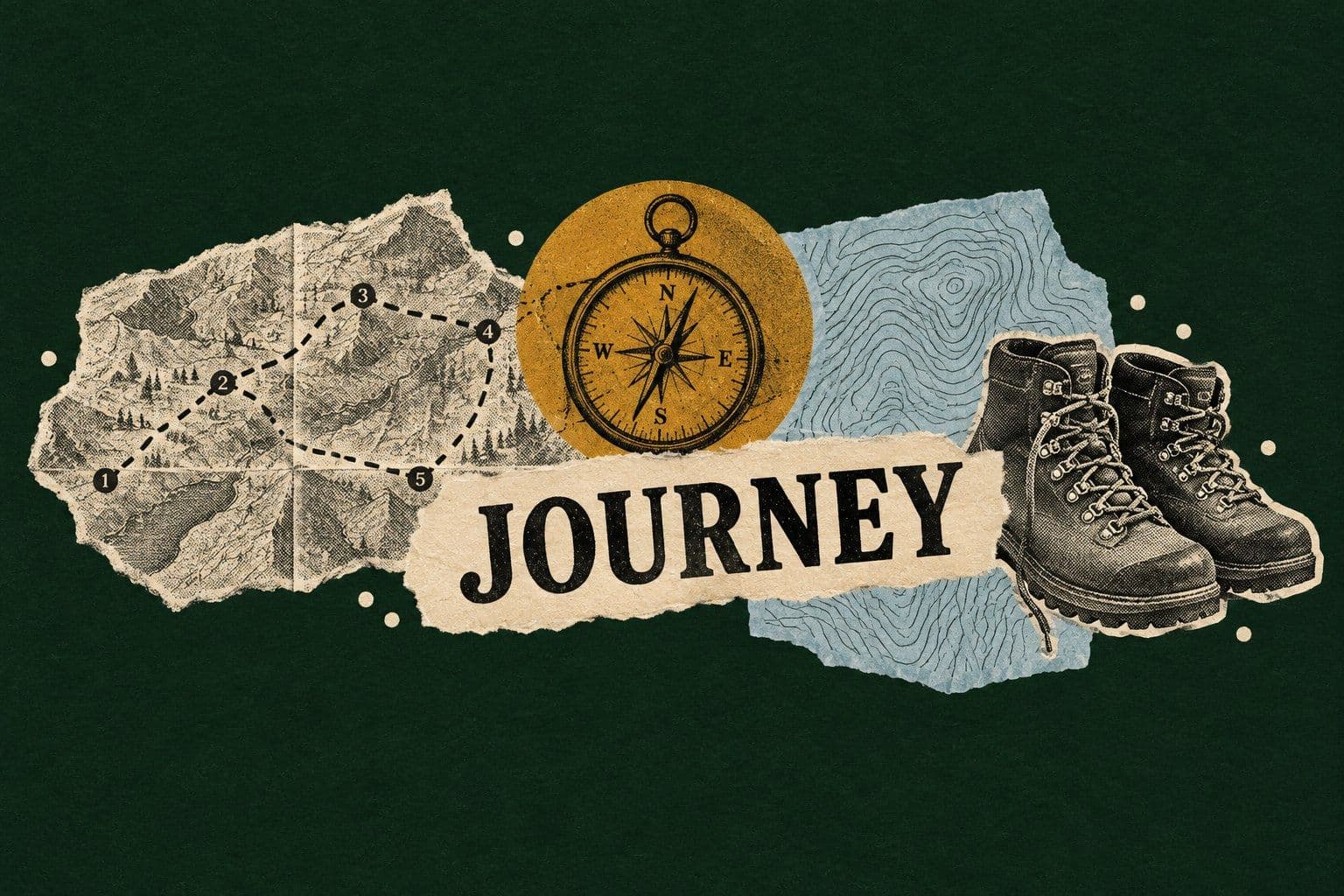
A customer journey map is a simple way of seeing all of it at once. You can make your first one in an afternoon.
Step 1: Pick one customer
A journey map for everybody is useless. Take one of your customer profiles and do that one. In B2B, remember that the person using your product, the one running the evaluation and the one signing are often three different people. Choose the one who matters most, and note where the others come in.
Step 2: Draw the stages from their side
Get people from sales, marketing, delivery and support in a room. Write the stages across a wall, in your customer's words. Avoid your own sales stages here, because they describe your process. This describes theirs.
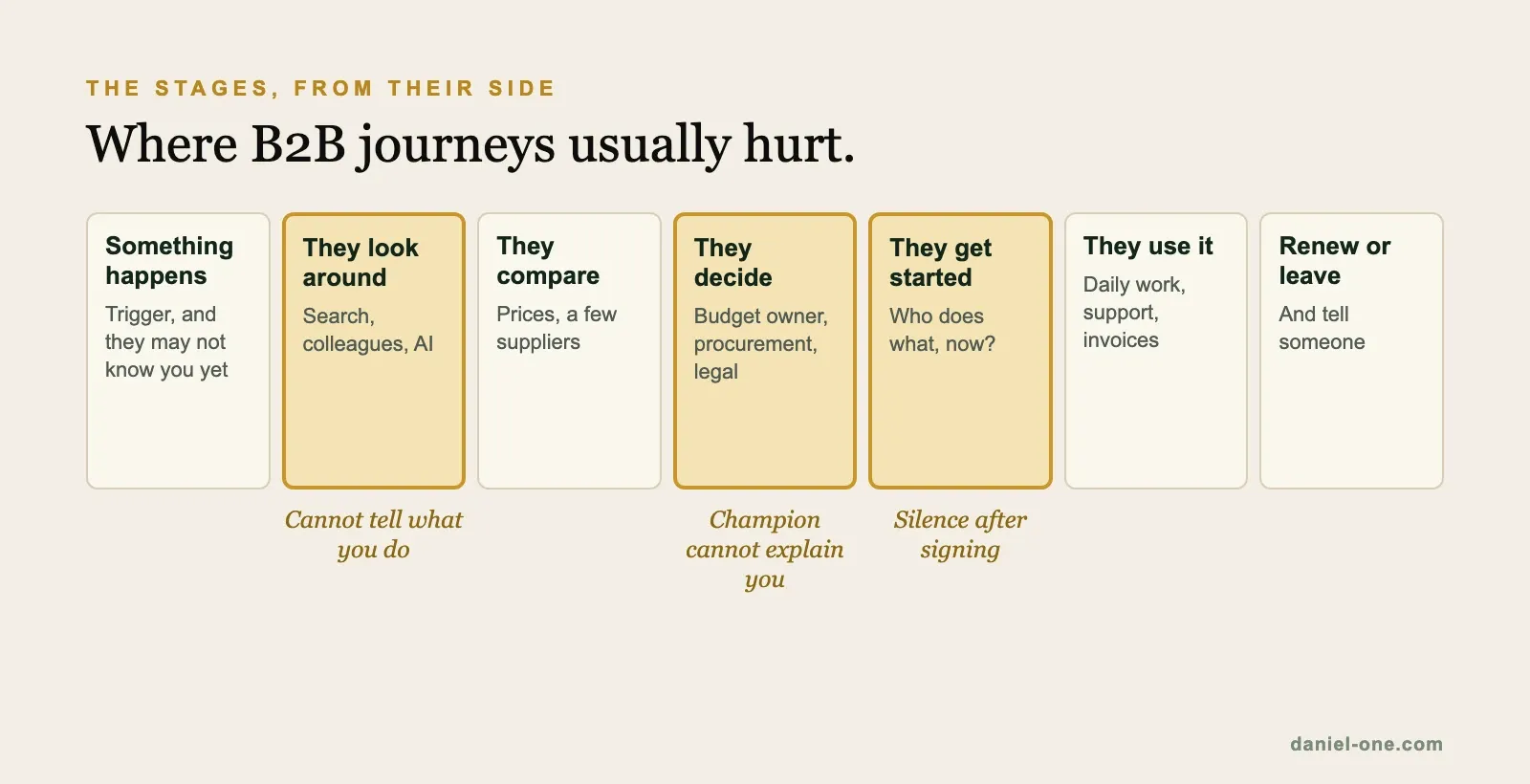
A typical B2B journey looks like this:
- Something happens. A trigger starts it: growth, a new boss, a failed project. They may not yet know you exist.
- They look around. They search, ask colleagues, ask AI and read.
- They compare. They talk to a few suppliers, ask for prices, and bring in colleagues.
- They decide. They get it past the budget owner, procurement and legal.
- They get started. The contract is signed, and now somebody has to make it work.
- They use it. Daily work, support, invoices.
- They renew or leave. And perhaps tell somebody else about you.
Step 3: Fill in what really happens
For each stage, write down on sticky notes:
- What are they trying to do?
- Where do they meet you? Website, email, a call, a contract, an invoice, the support desk.
- What are they thinking and feeling?
- Who else is involved?
Then find out if you are right. Most of what you just wrote is a guess. Go and ask a few recent clients. Listen to your recorded calls. Try it yourself: fill in your own contact form, ask for a price, and read your own onboarding email as if you had never heard of you. Founders are often shocked by this one.
Step 4: Find where it hurts
Now go through the wall and mark the places where people get stuck, get frustrated or disappear. In B2B, these come up again and again:
- They cannot tell what you do. Your website makes sense to you and to nobody else.
- They cannot find a price, and they move on to someone who shows one.
- Your champion cannot explain you internally. The buyer loves you and forwards your website to the finance director, who cannot tell what you do. A short, clear document can save the deal.
- Procurement stalls for weeks because you have to look for your security answers.
- The silence after signing. Sales goes quiet, and nobody says what happens next.
- Rigid packages that do not fit what the client needs.
- Invoices nobody understands. Unclear costs make people nervous, and that hurts trust.
Step 5: Decide what to fix first
You will have too many ideas. Rank them by how many clients it affects, how much it costs you when it goes wrong, and how hard it is to fix. A few small fixes usually come first: a clear page on what happens after signing, a welcome call, a ready answer to the ten questions procurement always asks.
Some fixes are bigger. CapillaryFlow sells to golf courses, equestrian centres and sports fields, and each market had its own website and its own story, so buyers who were only looking around got a confusing first impression. We worked out what buyers in each market needed and brought it together in one site. Direct sales leads from equestrian buyers grew 777% in a year.
Design the high point and the ending
People do not remember an experience as an average. Daniel Kahneman showed this in a study so odd that it is hard to forget. People held a hand in painfully cold water for 60 seconds. Then they did it again with the other hand, for 60 seconds at the same temperature, plus 30 more seconds with the water very slightly warmer. Asked which one they would rather repeat, most chose the longer one. It hurt for longer, and it ended better.
A later study of colonoscopy patients found the same thing. Patients who had three extra minutes of mild discomfort at the end rated the whole procedure as less unpleasant, and were more likely to come back for the next one. Kahneman called it the peak-end rule: we judge an experience mostly by how it felt at its most intense moment and at the end. Later research suggests the rule is not the whole story, and it is still one of the most useful things you can know when you look at your map.
Chip and Dan Heath built a very good book on this idea, The Power of Moments. For your journey, it means three things:
- Fix the worst moment first. One terrible week in procurement can colour the next three years.
- Build one high point on purpose. The first useful result is the obvious candidate. Make sure it happens early, and that everyone sees it.
- Take care of the ending. A project report that shows what was achieved. A renewal conversation that looks forward. A client who leaves, and is treated well on the way out, can still recommend you.
Then look for places where you could do something unexpectedly well, as Vaynerchuk did with his show. What does your customer get from you that they could not get from anyone else? It could be what you teach them, how you prepare for a meeting, or a piece of advice that has nothing to do with what you sell. That is often what people tell their colleagues about.
Be careful about copying. A clever idea from a shoe shop or a software company came from understanding their customers. Your customers have other needs.
Step 6: Write it down and keep it alive
Put the map on one page, with the pain points, what you will fix, who owns it and by when. Share it, and use it to onboard everyone who joins. Look at it again once or twice a year, and whenever you hear the same complaint twice.
This belongs to step six in how to win new B2B clients, because the journey is where clients decide to stay and where most of the reasons they leave begin.
Doug Dietz had worked on scanners for twenty years, and it took one hallway to change what he saw. Go and stand in yours.
Want help mapping it? We run this as a workshop at Up Strategy Lab.
Frequently asked questions
What is a customer journey map?
A simple picture of everything a customer goes through with you, from the moment they start looking until they renew or leave. It shows what they are trying to do, where they meet you, and what they think and feel at each stage, so that you can see where it goes wrong.
How do you create a B2B customer journey map?
Pick one customer profile, get sales, marketing, delivery and support in a room, and write the stages across a wall from the customer's side. Fill in what happens at each stage, check it with recent clients, mark the pain points, and decide what to fix first.
What are the stages of a B2B customer journey?
A typical journey runs through something happening that starts the search, looking around, comparing suppliers, deciding, getting started, using the product or service, and renewing or leaving. Use your customers' words, and adapt the stages to what really happens in your market.
How is a B2B customer journey different from B2C?
It takes longer and involves more people. The user, the evaluator and the person signing are often different, and each has a different experience of you. Much of the journey happens without you, inside the customer's company, so your champion needs material to explain you.
What is the peak-end rule?
A finding by Daniel Kahneman and colleagues: people judge an experience mostly by how it felt at its most intense moment and at the end, rather than by its average. For a customer journey, that means fixing the worst moment first, building one high point on purpose and taking care of how things end.
How long does it take to make a customer journey map?
A useful first version takes an afternoon with the right people in the room. Checking it with clients takes a few weeks. Do not wait for it to be perfect.
The Visibility Edge
Tested ideas on building better B2B companies, when there is something worth sending.