
Most articles on getting clients are a list of 25 tactics. I have read a lot of them. They are not wrong, and they do not help, because they cannot tell you where to start.
So I will tell you what happened to us. At MuchSkills, the skills platform I co-founded, we recently went through 880 recorded conversations with buyers, customers and partners, across about 400 organisations to find out what came before our wins. Some of it surprised me, and one thing changed how I think about all of this: on the wins we looked at, the buyer started the conversation.
People with a problem go looking
When somebody has a problem, they go and look for a solution. They ask Google or Microsoft's search. They ask ChatGPT, Claude or Copilot. They ask a colleague, a partner or someone they trust on LinkedIn.
That is how most of the organisations we talk to reached us. They found us. Some came through Google or ChatGPT, others through a form on our site, our pricing page, a Microsoft ad, a partner or a public framework that buyers use to procure.
Every one of those is the buyer starting the conversation. All our work happened earlier: being findable, being understandable and being on the list on the day someone needed us.
Bob Moesta, who spent years developing the jobs to be done idea with Clay Christensen, makes the same argument in Demand-Side Sales 101. Demand comes from what he calls a struggling moment. Until someone is struggling, there is very little you can do to make them buy.
And most people, most of the time, are not struggling yet. John Dawes of the Ehrenberg-Bass Institute estimated in work for LinkedIn's B2B Institute that only about 5% of B2B buyers are in the market at any one time. He is careful to say that the number is a rough guide, and it will differ for your category. The point stands. Most of the people you want are not ignoring you. Nothing has happened to them yet. When it does, they will go looking, and you want to be what they find.
Find out if you can be found
You can test this in ten minutes, and I would do it before you spend anything on outreach.
Write down ten sentences your buyer would type on the day the problem hits. Use their words. A head of engineering who has just lost a bid does not type "competence management platform". They type something like "how do we prove our engineers' certifications to a client".
Now type those sentences into Google, Microsoft's Bing and Copilot, ChatGPT and Claude. Are you there? Who is? When an AI tool mentions you, is what it says true?
Most companies have never done this. The first time is often uncomfortable. Then you can start fixing it:
- Answer the question they are asking. One clear page per problem, in the buyer's words. A page about your features answers a question nobody typed. Teach them something too: in The Challenger Sale, Matthew Dixon and Brent Adamson found that the strongest B2B sellers teach customers something new about their own business, and a good page can do that before you have met.
- Say plainly what you do and who it is for. A person skimming and an AI tool summarising both need to be able to repeat it. If they cannot, your positioning is the first thing to fix.
- Show a price, or at least a range. A pricing page brought us a client. A buyer who cannot find a price often moves on to someone who shows one.
- Be on the lists. Review sites, partner directories, framework agreements, award lists. Buyers read them, and so does AI.
- Do not forget Microsoft. It is easy to think only about Google. One of our clients came from a Microsoft ad.
- Make yourself easy to check. Forrester says that genAI searches are the starting point for B2B buyers, and also that buyers do not fully trust the answers, so they go on to confirm them with sources they trust. Named clients, real results and a real person behind the company all help.
This is slow, and it compounds. My guides on this site have reached more than 500,000 readers. At MuchSkills, AI search now sends us buyers who found us simply by asking. It can change a whole company. Donald Axelsson Cardell, CEO of Optimal Kommunikation, says it better than I can: "We used to find our own clients by picking up the phone and calling them." They went from no web leads to between 70 and 90 qualified leads a month.
Something always happened first
This was the most useful thing we found. Buyers did not wake up one morning wanting a skills platform. Something had happened to them:
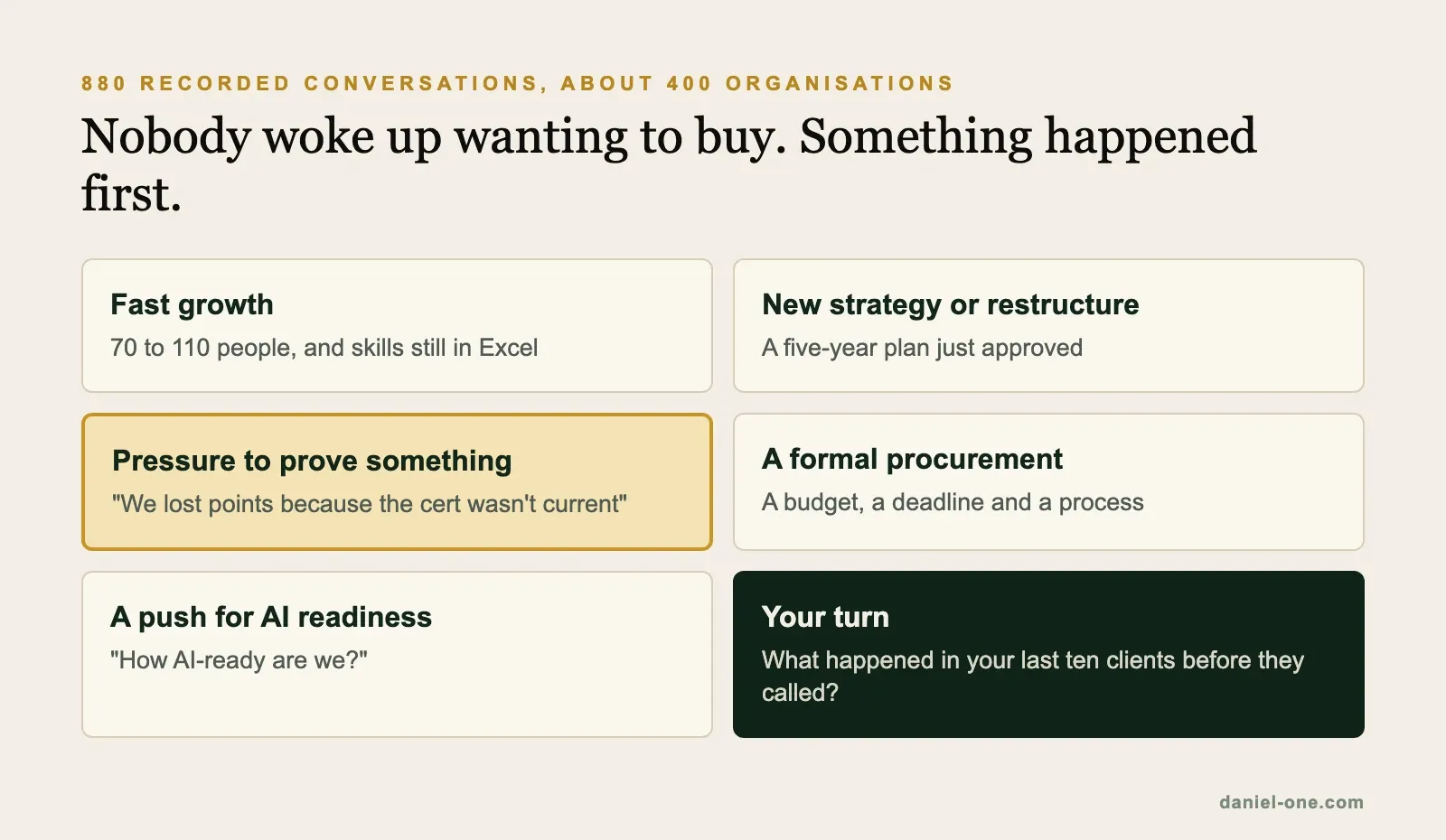
- Fast growth. One company had gone from 70 to 110 people with 150 in sight, and its skills data was still in Excel.
- A new strategy or a restructure. A five-year strategy had just been approved, or a new owner wanted the organisation aligned.
- Pressure to prove something. One buyer told us: "We lost points because the cert wasn't current."
- A formal procurement. Someone had a budget and a deadline, and had to look.
- A push for AI readiness. Leadership had asked how ready the company was, and nobody could answer.
Your triggers will be different. The method is the same. Go through your last ten clients, and for each one ask: what happened in their company in the months before they called us? If you record your sales calls, it is all in the transcripts. If you do not, ask them. They will remember.
This gives you two things. You learn what to write about, because each trigger is a search someone is about to make. And you get a list of things to watch for: new leaders in the role you sell to, job ads, funding rounds, tenders, new regulation in their sector. That is a far better list than a thousand names who fit a job title.
Try many things, and keep score
Being found is the base. You can also go out and start conversations, and here I will be careful, because nobody can tell you in advance what will work for you. I certainly cannot.
Take cold email. We have sent thousands of cold emails across many campaigns, and only a handful of real conversations came out of them. It is much harder, and timing is a big part of why. Even if you can see that a company has the problem, it may not be the moment they need a solution, and they may not be aware of it yet. Please do not read too much into our experience. It also tells you about our offer, our lists and our market at the time. If our email had said "reply and I will send you a million dollars", we would have had plenty of replies. Someone with a different offer or a sharper list may do far better. We are still sending it, because every real conversation is with a company we would not otherwise have met.
The only honest answer is to run experiments. Gabriel Weinberg, the founder of DuckDuckGo, and Justin Mares wrote a whole book about this called Traction. They list 19 channels a company can use to get customers, and argue that most teams only ever consider the few they already know. Their method is simple: think of one idea for every channel, run cheap tests on the most promising, and put your effort into whichever one proves itself. When it stops working, as it will, start again.
What makes this work is keeping score the same way everywhere:
- Give each test a small budget and a fixed end date.
- Write down in advance what would count as success.
- Compare everything on the same numbers: cost per real conversation, cost per booked meeting and cost per client. The maths is here.
- Stop the ones that fail, and try the next idea. A failed test that cost little is a good result.
Testing demand has more on how to design a test you can believe.
Where I would start
If I had to win clients from scratch tomorrow, I would start on being findable right away, because it pays for everything else. Alongside that, this is the order I would try things in. It runs from cheapest and most likely to most expensive and least certain, and your order may well end up different.
1. People who already know you. Write a list of everyone who has ever bought from you, worked with you or said something kind about your work. Write to each of them personally. Tell them what you are doing now and who you can help, and ask one question. Almost everyone skips this because it feels awkward, and it is the highest reply rate you will ever get.
2. Buyers who almost said yes. We recently went back through about 85 stalled deals, and only 15 cleared the bar of having something real to say. Each one got an email built on what they had told us and what had changed since. The people who said "not now" a year ago know who you are, and now may be the moment. It is too early for me to give you results, but it took far less effort than finding strangers.
3. Referrals. The best time to ask is right after you have delivered something good. Be specific: "Do you know one other head of sales who is struggling with this?" gets an answer. "Let me know if you hear of anyone" does not. Make it easy by writing the introduction for them.
4. One-to-one emails with a real reason. Pick a few companies where one of your triggers just happened. Find the person who feels the problem. Write as you would to someone you respect: this is what I noticed, this is why I thought of you, is it relevant? We limit ourselves to fewer than ten a week so that each one can be properly researched. Make it about that one company, because a hook about a whole sector has never made anyone reply to us. And find the budget owner early. Our two best cold email conversations came from someone who lived the problem daily, and both died when it reached the managing director or the head of quality, who did not. Give your champion what they need to convince that person, and do not go around your champion.
This will feel small, and it should. Paul Graham's essay Do Things That Don't Scale tells how Airbnb's founders went door to door in New York, recruiting users and helping them improve their listings. When someone agreed to try Stripe, the Collison brothers would say "Right then, give me your laptop" and set them up on the spot. Y Combinator still calls it the Collison installation.
5. Partners. If someone already sits in the room with your customers, they can take you places you would never reach. At Appland, one and a half people ended up selling to more than 100 mobile operators in 40 countries this way. It takes real work to get right, and the guide shows how.
6. Events. Be selective, and do the work before you go. Before UNLEASH in Paris this year, we sent personal notes to more than 40 people we wanted to meet. The conversations you book in advance are worth more than the ones you hope to have at the stand. And know when to move on. Sourcing Allies depended on trade fairs until we built them a system that finds serious buyers, and their cost per lead fell from $2,000 to $100.
7. Cold email and paid ads at volume. These can work, and it depends a lot on your offer. Try them as experiments once you know what you can pay and what you want to say. Run them too early and you may only find out that your message is unclear, at some expense. Check your list by hand as well. One of ours was fed by an enrichment workflow that had failed hundreds of times, and another had tagged every account with the same partnerships. Nobody replies to an email about a situation they are not in.
None of this works if the first steps are missing
If you are getting no replies anywhere, the problem is rarely the channel. Usually you have not decided who you want, or the reader cannot tell why you are different. That is why this is step five in how to win new B2B clients.
And a reply is only worth what you do with it. A sales process that mirrors how your customer buys and a presentation that answers their questions are what turn a reply into a client.
But it all comes back to what we found in those 880 conversations. Something is going to happen at a company you would love to work with. Someone there will go looking for help. The only question is what they will find.
Want help making sure it is you? Talk to us at Up Strategy Lab.
Frequently asked questions
What is the best way to get new B2B clients?
Make sure you can be found when someone has the problem you solve, through AI tools, Google, Microsoft search, partners and colleagues. Alongside that, start with people who already know you, then buyers who almost said yes, referrals and one-to-one emails to companies where something has just happened. Then test other channels and compare them on cost per client.
How do I make my company easier to find?
Write down ten sentences your buyer would type on the day the problem hits, and try them in Google, Bing, Copilot, ChatGPT and Claude. See who shows up and what is said about you. Then publish clear pages that answer those questions in the buyer's words, say plainly what you do and who it is for, and get onto the review sites, directories and lists your buyers read.
How do you get found in AI search?
AI tools repeat what they can find and understand. Say clearly what you do, who it is for and what problem you solve, on your own site and on sites others trust. Answer real questions in plain language, and check regularly what the tools say about you. Buyers often confirm AI answers elsewhere, so real clients and real results matter as well.
Does cold email still work for B2B?
It can, and it depends heavily on your offer, your list and your market, so the only way to know is to test it. We have sent thousands of cold emails across many campaigns and got only a handful of real conversations. That says as much about our offer and the timing as about the channel. Treat any number you read, including ours, as one data point.
How do I get my first clients with no network?
Find the places where your buyers already gather, go there and talk to them. Offer a small, specific piece of useful work. Write publicly about the problem you solve, so that people can find you when they have it. Look for companies that serve the same customers as you, because they can introduce you. Your first clients usually come from conversations, rarely from campaigns.
What is a buying trigger?
Something that happens in a company and makes your offer relevant now: fast growth, a new leader, a restructure, a new regulation, a tender, a failed project. Go through your last ten clients and ask what happened in the months before they called you. Then watch for the same events at other companies, and write about them.
How do you ask for a referral?
Ask soon after you have delivered something good, and be specific about who you are looking for. "Do you know one other head of sales who is struggling with this?" gets an answer. Offer to write the introduction yourself, so that all they have to do is forward it.
The Visibility Edge
Tested ideas on building better B2B companies, when there is something worth sending.