Think about what a good salesperson knows after three years. Which customers mean what by "too expensive". Why that deal died. What the buyer at a manufacturing firm worries about at two in the morning. Which promises get you into trouble.
Now think about what happens when that person leaves. It goes with them.
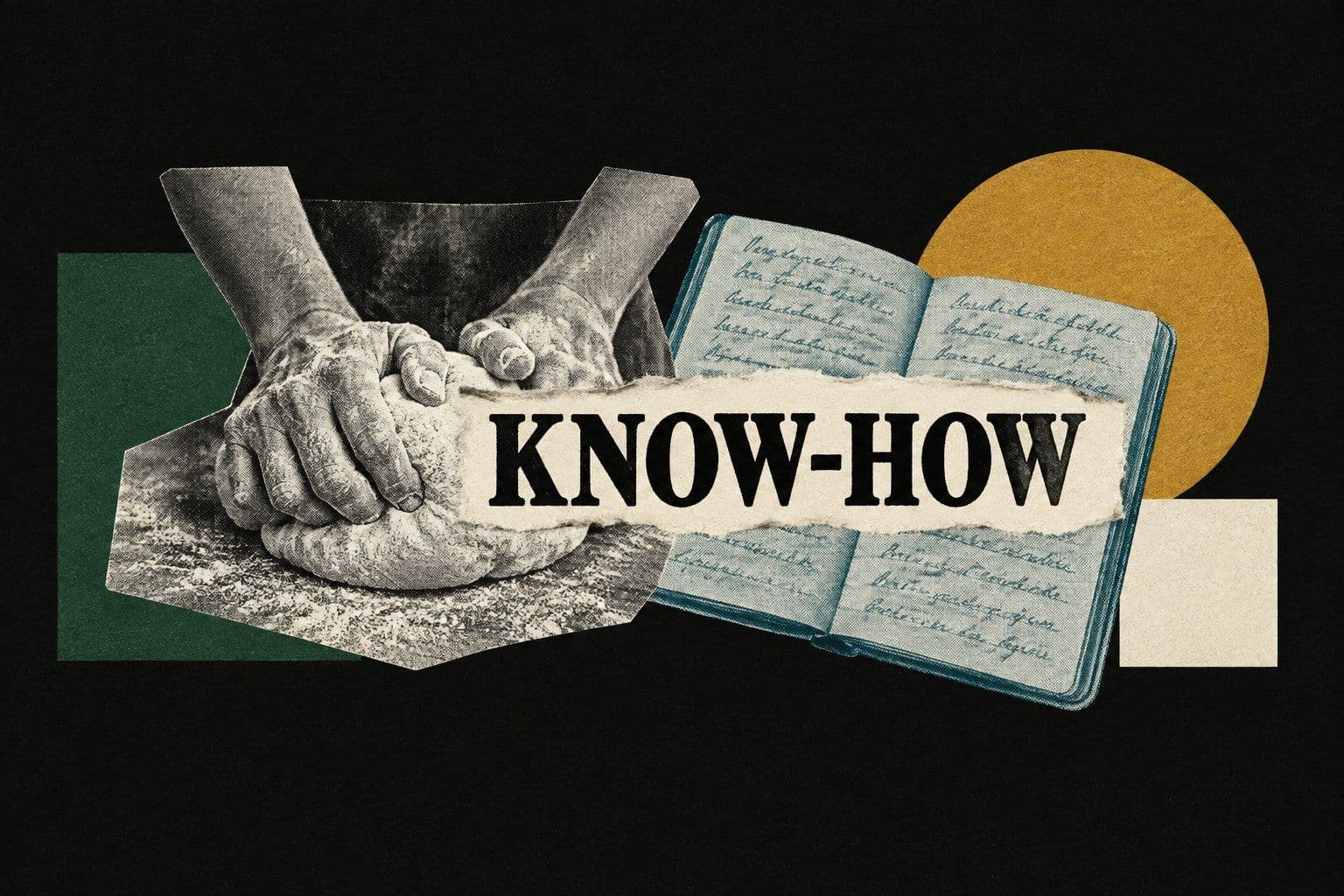
In 1985, engineers at Matsushita in Osaka were trying to build a home bread-making machine, and the bread was terrible. They X-rayed dough made by the machine and dough made by professionals, and it told them nothing useful. So a software developer named Ikuko Tanaka had an idea. The Osaka International Hotel was known for the best bread in the city, so she went and trained with its head baker. After a while she noticed something he did not know how to tell anyone: he did not only stretch the dough, he twisted it as well. She took that back to the engineers, and the machine became a major success. Ikujiro Nonaka tells the story in The Knowledge-Creating Company.
The philosopher Michael Polanyi put it in one line in 1966: "we can know more than we can tell". Your best salesperson is that baker. Ask them how they do it, and they will give you a tidy answer that leaves out the twist. Somebody has to go and stand next to them.
Most companies are like this. The founders understand the customer deeply, because they sold the first twenty deals themselves. That understanding never gets written down. New people are told to read the website and shadow someone for a week. Marketing writes for one customer, sales talks to another and product builds for a third. Then everyone wonders why it does not add up.
If you have done the work in this series, you now know a great deal: who you want, what they are worth, what they say in their own words and why they leave. It is one of the most valuable things your company owns. Do not let it fade.
Why your experts are the wrong people to explain it
In 1990, a Stanford graduate student named Elizabeth Newton ran a simple experiment. One group of people tapped out the rhythm of well-known songs on a table, and another group tried to name the song. The tappers predicted that listeners would get it right half the time. Out of 120 songs, listeners got three. That is 2.5 percent.
The tappers could hear the tune in their heads, and the listeners only heard knocking. Chip and Dan Heath made this story famous in Made to Stick, and they call it the curse of knowledge. Once you know something, it is very hard to imagine not knowing it.
This is exactly what happens when a founder explains the customer to a new colleague. They can hear the whole tune: every deal, every lost client, every odd thing a buyer once said. The new person hears knocking. So write the document with someone who is new, and test it on someone who is newer.
Write the one document
Start here, because everything else builds on it. Write a document so clear that someone who started this morning can read it and understand who you serve. I would include these parts:
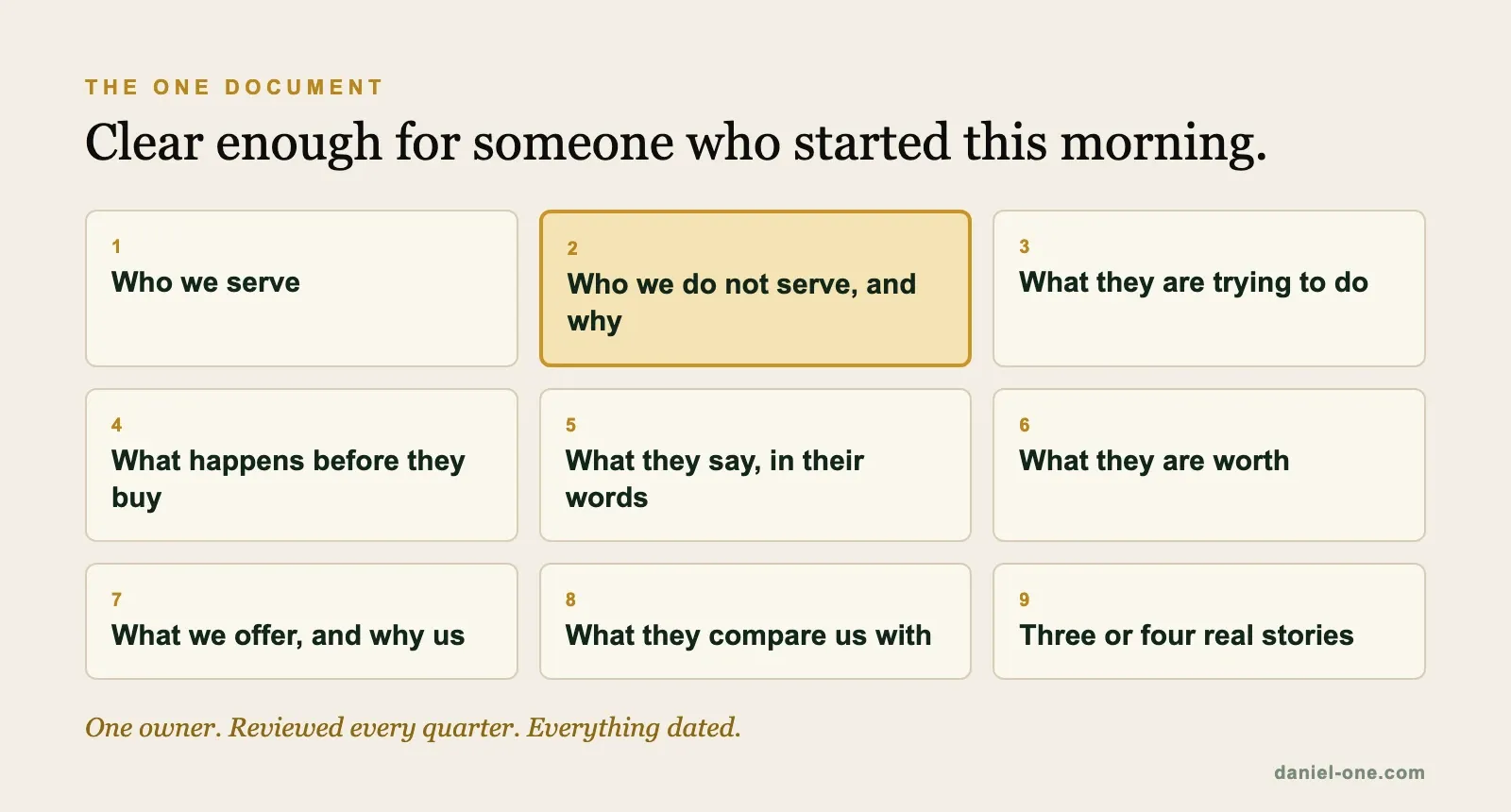
- Who we serve. Your ideal segments and buyer personas, described so that you can recognise them.
- Who we do not serve, and why. New salespeople need this most of all. It can be as plain as: "Firms under 20 people. They love the idea, cannot fund the rollout and leave within a year."
- What they are trying to do. Their jobs, pains and gains, ranked.
- What happens before they buy. The triggers, and how they usually find you.
- What they say. Real quotes. How customers describe the problem, in their words.
- What they are worth. The numbers per segment, so that people understand why you focus where you do.
- What we offer them, and why us. Your value proposition and your positioning.
- What they compare us with, and the objections we hear, with the answers that have worked.
- Stories. Three or four real customers, including one where it went wrong.
Put it somewhere everyone can find it, not in somebody's private folder. Keep it short enough that people will read it, and link to the detail.
Turn it into training
A document on its own does not change how people work. You can build a simple programme around it without any special tools.
Put it in the first week. Every new person, in every role, goes through it. The developer and the finance manager need to know who the customer is too. Have the founder or your best salesperson run it, so that people understand it matters.
A first day can do a lot. Chip Heath describes how John Deere welcomes new engineers in India. A friend they have already been writing to meets them with their favourite drink. The desk is ready. The first email from the CEO talks about the company's long history and how its products provide food and shelter. On the desk is a model of the first plough John Deere patented. By lunchtime you know what you have joined. Compare that with a laptop and a login, which he calls "a huge missed opportunity". You could do your own version with a recording of a real customer and one good story.
Use real material. Play recordings of real sales calls. Read real emails from angry customers. Use the actual objection someone heard last week. People remember a customer's voice far longer than they remember a slide.
Jeff Bezos is said to have left an empty chair in meetings to represent the customer. It is a nice idea, but a chair never corrects you. A recording will. One good first session: the founder plays a call from a lost deal, stops it at the moment it went wrong, and asks the new colleague what they would have said.
Make people do something with it. Ask a new salesperson to explain your ideal customer in two minutes, or to handle an objection. Have a developer listen to five calls and report back what surprised them. Spend a day in support.
Do not stop after the first week. Short sessions a few times a year work better than one big day. Share a good customer quote or a lost deal in your regular meetings. For the sales team, this should be part of your sales training programme.
Keep it true
Here is where most of these efforts die. Someone writes a fine document, it is right for six months, and then nobody trusts it. You need very little to prevent that.
Give it one owner. A named person, not a committee. In a small company it might be whoever runs sales or marketing.
Decide where the information comes from. Sales calls, surveys, support tickets, lost deals, your CRM.
Set a rhythm. Look at it every quarter, or more often if your company is young and still learning. Ask what changed: who bought, who left, what we heard that we had not heard before.
Date everything. Then people can see what is fresh and what may be old.
Keep anything that changes weekly out of it. Deal stages and what a customer is paying belong in your CRM. The document holds what changes slowly.
Give it to your AI as well
There is one more reader now. AI starts where every new hire starts: it knows almost everything except your customers. Ask it to write to a prospect with no context, and you get a polite email to a generic head of something about unlocking potential. It will not learn your customers by working with you, so it needs the same material. Give it the document, and it knows who you say no to and the words your buyers use.
I went further and built a second brain, which captures what we learn from every conversation and turns it into pages for each customer. Before a call, one command prints what we know about that company and what nobody has asked yet. It is written down without anyone having to remember to do it, which has solved most of the keeping-it-true problem for me. But it starts with the same thing: decide what you know, and write it down.
A test you can run tomorrow
Ask five people in your company, from different teams, to answer three questions separately:
- Who is our ideal customer?
- Who is not?
- Why do people choose us?
If you get five different answers, you have found out why marketing, sales and product keep pulling in different directions, and you know what to write first.
Those differences are the job. Get the five of them in a room, go through the answers and write down what you agree on. That is the first page of your document, and it is step seven in how to win new B2B clients, the one that makes the other six last.
Want help building it? Talk to us at Up Strategy Lab.
Frequently asked questions
How do you train employees to understand your customers?
Write one clear document about who you serve, who you do not, what they want and what they say. Put it in everyone's first week, whatever their role. Use real sales calls and real customer emails, make people do something with the material, and return to it with short sessions a few times a year.
What should an ideal customer training programme include?
Your segments and buyer personas, who you say no to, their ranked priorities, what triggers a purchase, real customer quotes, the numbers per segment, your value proposition, your competitors, common objections with answers, and three or four real customer stories.
How do you keep customer knowledge up to date?
Give one named person the job, decide where new information comes from, and review it every quarter. Date everything, and keep anything that changes weekly in your CRM rather than in the document.
Why does customer knowledge get lost in companies?
It usually lives in the heads of the founders and a few experienced salespeople, and it is never written down. When people leave or the company grows, it goes with them. New people then learn from the website and a week of shadowing.
What is tacit knowledge?
Knowledge people have and use without being able to explain it, like a baker's feel for dough or a salesperson's sense of when a deal is real. Michael Polanyi described it as knowing more than we can tell. To capture it, you usually have to watch people work and ask questions, because they will not think to mention it.
What is the curse of knowledge?
Once you know something, it is hard to imagine not knowing it. In Elizabeth Newton's experiment, people tapping out songs expected listeners to name half of them, and listeners named 2.5 percent. It is why experts are often poor at explaining what new colleagues need to know.
Can AI use the same customer knowledge as my team?
Yes. AI needs the same context as a new colleague, because it does not learn your customers by working with you. Split the knowledge into small files so that it can pull only what a task needs. A second brain is one way of doing this.
The Visibility Edge
Tested ideas on building better B2B companies, when there is something worth sending.