In 1984, IBM dominated personal computers. Apple had a new machine to launch and nothing like IBM's reach. So Steve Jobs did not try to compete on IBM's terms. He saw IBM as Big Brother, and Apple as the last chance to escape it. Ridley Scott made the commercial, and it ran during the Super Bowl.
It worked. Apple had predicted it would sell 50,000 Macs in the first 100 days, and reached that on day 73.
You will not make a film with Ridley Scott. But the thinking holds up: Apple looked at what buyers could choose instead, found something the market leader could never credibly claim, and built everything around it. That is competitor analysis and positioning, and you can do a useful version in a day.
Step 1: Write down what your customer could do instead
Start wider than your direct competitors, because your buyer does. April Dunford, whose book Obviously Awesome is the best modern guide to this, starts with one question: what would your customers do if you did not exist? The answer is often a spreadsheet, or nothing at all. A restaurant competes with other restaurants, and also with meal kits, supermarkets and last night's leftovers.
In B2B, the alternatives are usually:
- Direct competitors, who offer roughly what you offer
- Big platforms where your product is one module among many
- A spreadsheet, or whatever they do today
- Building it themselves
- Hiring someone, or a consultant
- Doing nothing, which is the most common decision of all
This matters more than it used to. At MuchSkills we have recently met buyers who are weighing us against building their own version with AI. Two years ago that was not on my list. If you only analyse the companies on your competitor page, you will miss what you are actually losing to.
Ask your customers what they compared you with. Look through your lost deals. Search for your category the way a buyer would, and ask a few AI tools which providers they would recommend. Keep it to five or so that really matter.
Step 2: Compare what your customers care about
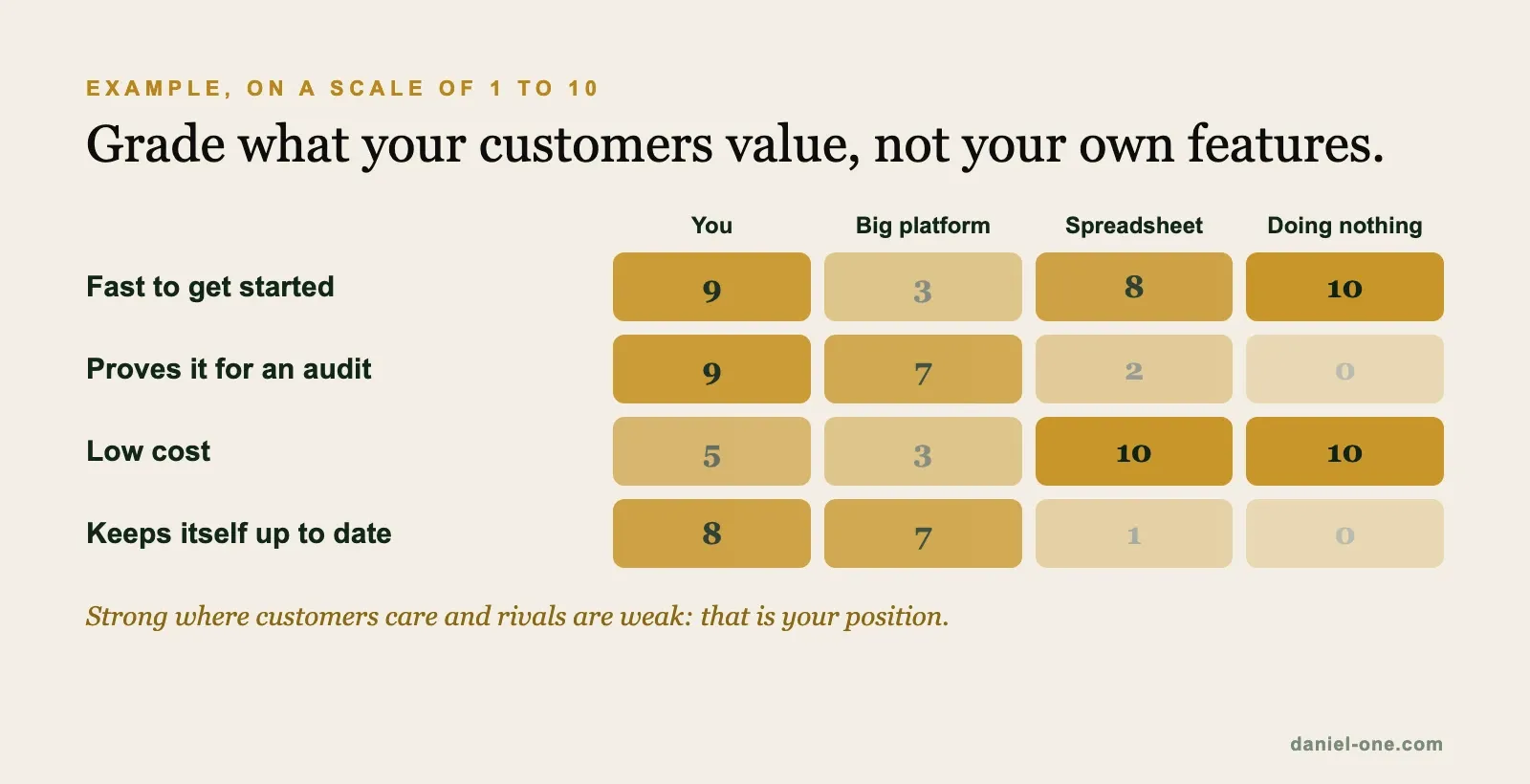
Here is the mistake I see most often. Companies build a comparison around their own features, and naturally they win. A comparison like that tells you nothing.
Start from what your customers told you matters most. If you have not ranked it yet, the value proposition guide shows how, or ask five recent customers what made them choose and what nearly stopped them. Put those priorities down the side, and the alternatives across the top. Then grade each one, honestly. I use this simple template, and I have used it for years.
Look for three things:
- Where everyone is strong. That is the price of entry. Stop leading with it.
- Where you are ahead on something customers rank highly. That is your position.
- Where you lose on something that matters. Fix it, or stop going after the customers who care most about it.
Do the grading with people who talk to customers. If the founder does it alone, you will win on everything.
Step 3: Look at how they present themselves
Take screenshots of your competitors' home pages, put them on a big canvas next to yours, and hide the logos. Can you tell them apart? Can you tell which one is you?
Usually you cannot. Everyone is "the leading platform" that "empowers teams". I wrote about why B2B positioning sounds the same, and this exercise is the fastest way to see it in your own market. Note the words everyone uses, and stay away from them. Note what nobody talks about. That gap can be worth a lot.
While you are there, record what they offer, who they say it is for, what they charge if they show it, and what their customers complain about in reviews.
Step 4: Write your positioning statement
Now write it down. Geoffrey Moore popularised this template in Crossing the Chasm back in 1991. It is old, and it still works, because it forces you to make the choices you have been avoiding:
For [who], who [have this situation], [your company] is the [category] that [main benefit]. Unlike [the main alternative], we [what is really different].
Three made-up B2B examples:
For engineering firms of 50 to 500 people, who lose bids because they cannot prove their certifications in time, Northline is the compliance tool that has every certificate ready in minutes. Unlike a spreadsheet, it warns the holder before anything expires.
For founders of funded B2B software companies, whose product is too complex to explain on a home page, Fieldwork is the design studio that makes it understandable to a buyer in thirty seconds. Unlike a brand agency, we work directly with your product and sales teams.
For logistics companies with their own fleet, who have no time to run a tender for every route, Haulwise is the route planning service that saves a known number of kilometres each month. Unlike planning software, we do the work and you pay for the result.
Notice what they have in common. A reader can tell who it is for, and can tell if it is not for them. That is the point. If your statement could describe any of your competitors, keep going.
Then test the difference. Is it true? Can you prove it? Would a customer care? Could your biggest competitor say the same thing tomorrow? If they could, it is not your position.
The statement is for you, and it does not go on your website as it stands. It guides your home page, your sales presentation, your outbound and what you say when someone asks what you do. Then check that all of them actually say it. Most companies have a good statement in a document and something quite different on the website.
Done properly, it changes the conversations you have. When we rebuilt how Sourcing Allies present themselves, CEO Eric Bengtson told us it was now built "around the customers we actually want to work with", and that "the sales conversations we have now are better for it". Together with the new sales process, it took their sales lead time from two years to under six months.
Step 5: Look at your weakness again
Testing your statement may have turned up things you would rather not put on a page. Look at them again, because one of them may be your best position.
In the early 1960s, Avis was a distant second to Hertz in car rental. Hertz had three times the cars and five times the revenue. Avis had been losing money for years, and it went to the agency Doyle Dane Bernbach with not much to boast about. When the agency asked what Avis could honestly claim, the answer came down to one thing: they tried harder, because they had to.
So Avis said it out loud. "Avis is only No. 2." "We try harder." Copywriter Paula Green wrote that Avis could not afford dirty ashtrays or unwashed cars, and everybody from the counter staff to the garage workers wore a We Try Harder button. Rentals rose 28%, and the company went from red to black.
Two things made it work. It was true, and it took something every competitor would hide and turned it into the reason to buy. Al Ries and Jack Trout, who wrote Positioning in 1981, would call that finding a place in the buyer's mind that nobody else holds. Hertz could never have said it.
Do this for your own company. List what buyers hold against you, and ask who might see it as a strength:
- You are small. So the founder answers the phone, and nothing goes through three layers of account managers.
- You are new. So there is no old system to migrate from, and you have no reason to defend how it has always been done.
- You do only one thing. So you are better at it than the platform where it is a side module.
- You cost more. So someone senior does the work.
It only works if it is true and you are prepared to live it. Avis had to clean those ashtrays.
Come back to it
This is part of step three in how to win new B2B clients. Markets move, as the arrival of AI as a competitor shows, so look at it again once or twice a year. And the moment you lose a deal to something that is not on your list, your list was wrong. Go back to step one.
If yours sounds like everyone else's, talk to us at Up Strategy Lab.
Frequently asked questions
What is a positioning statement?
A short internal sentence that says who you are for, what situation they are in, what category you belong to, what the main benefit is and what makes you different from their main alternative. It guides your website, sales material and outreach, and it is not usually published word for word.
How do you write a positioning statement?
Use this template: For [who], who [have this situation], [your company] is the [category] that [main benefit]. Unlike [the main alternative], we [what is really different]. Then test it: is it true, can you prove it, would a customer care, and could a competitor say the same?
How do you do a competitor analysis?
List the five or so alternatives your customer really considers, including doing nothing or building it themselves. Grade each one against what your customers value most, with people who talk to customers in the room. Then compare how they present themselves, and look for what nobody else can claim.
Who are my real competitors?
Whatever your buyer would do if you did not exist. That includes direct competitors, large platforms, spreadsheets, consultants, building it in-house and doing nothing. Ask your customers what they compared you with, and go through your lost deals.
How does a small company compete with a market leader?
Avoid fighting on the leader's terms. Find something that matters to a specific group of buyers and that the leader cannot credibly claim, as Avis did against Hertz with We Try Harder. Being small, new or focused can be the reason to choose you, if it is true and you live up to it.
How often should I update my competitor analysis?
Once or twice a year, and whenever you start losing deals to something new. Markets can change quickly, as AI has shown.
The Visibility Edge
Tested ideas on building better B2B companies, when there is something worth sending.