In the early 1980s, Prego was losing to Ragú. Like every food company at the time, it was looking for the perfect tomato sauce. So it brought in Howard Moskowitz, a market researcher with an unusual idea: there was no perfect sauce. There were several.
As Malcolm Gladwell tells it in his TED talk, Moskowitz made dozens of sauces and tested them on people around the country. The results did not point to a winner. They fell into three groups: people who liked it plain, people who liked it spicy, and people who liked it extra chunky. That third group was the discovery, because nobody sold extra chunky sauce. Prego launched one, and it took over the market.
What I love about this story is that no one had ever asked for it. If you had asked people what they wanted from a tomato sauce, nobody would have said extra chunky. You only find out by looking properly.
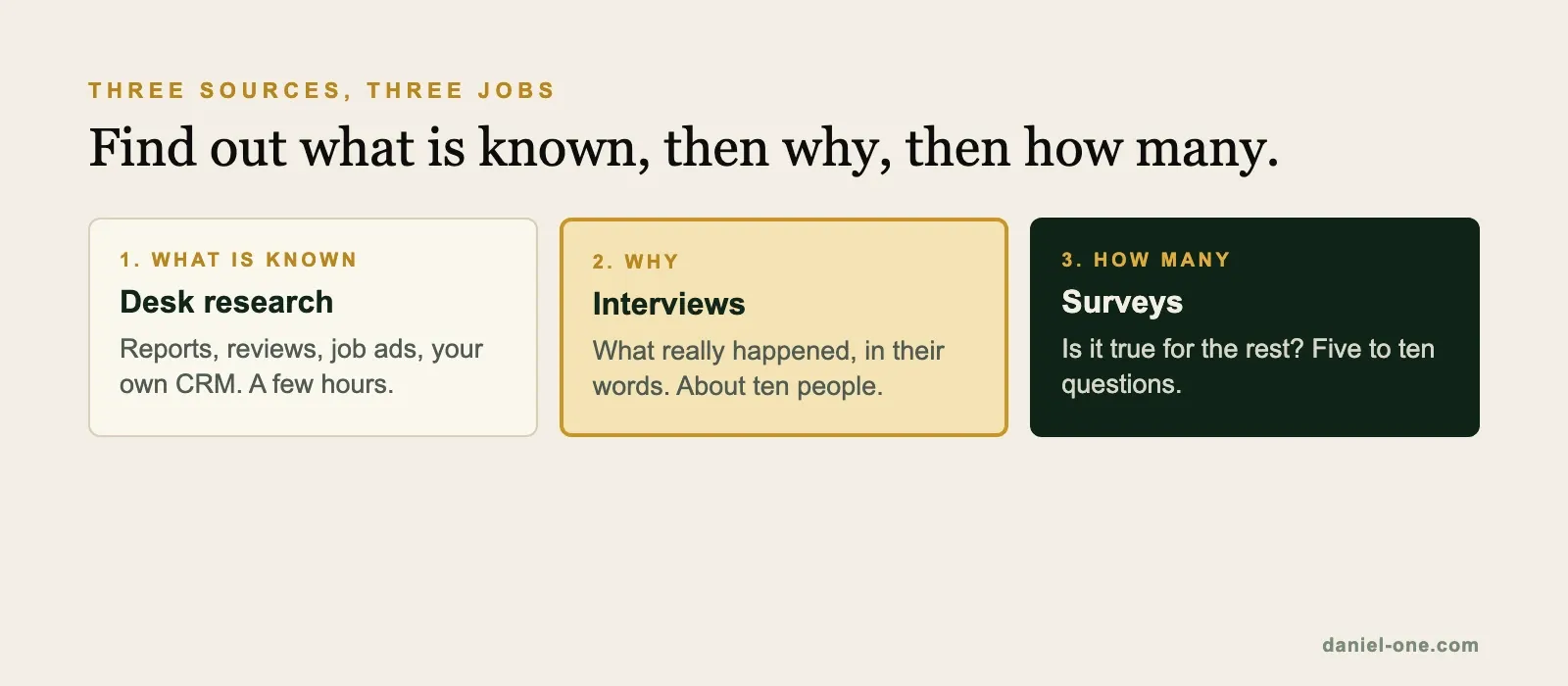
Most B2B companies do not look. They have opinions about their customers, and the opinions have been repeated in meetings for so long that they have become facts. This is how you replace them with something better. Start with what is already known, then talk to people and watch them, then run a survey. Then check what the numbers missed.
1. Start with what is already out there
Before you talk to anyone, spend a few hours finding out what is already known. There is an enormous amount of research, reports and data on most kinds of customers, and most of it is free.
Look for:
- Industry reports and surveys about the people you sell to
- What your customers publish: annual reports, strategies, job ads, leaders' posts
- Reviews of you and your competitors, especially the angry ones
- Forums and communities where your buyers ask each other for help
- Your own data: CRM notes, support tickets, won and lost deals
AI tools are very good at this first pass. Ask ChatGPT, Claude or whatever you use to find research on your customer's role and industry. Then open the sources and check them, because AI will happily invent a study that does not exist.
Put what you find in one short document and go through it with the team. The useful question is: what does this mean for what we offer and what we say?
2. Then talk to people
An interview gives you what no report can: why someone did what they did, in their own words. This is where your best ideas and best sales language come from.
Choose who to talk to. Recent buyers remember the most. Include people who said no, and people who left. Avoid your friends and your happiest fans. You will enjoy those conversations and learn little from them.
Ask about what happened, and stay away from what they would do. People are bad at predicting their behaviour and good at remembering it. "Would you pay for this?" gets you a polite yes. Rob Fitzpatrick wrote a short and very funny book about this, The Mom Test. His point is that your mother will tell you your business idea is wonderful, because she loves you, and most other people will too, because they are polite. So talk about their life and leave your idea out of it, ask about specifics in the past, and treat compliments as worthless. These questions get you the truth:
- What was happening in your company when you started looking?
- What had you tried before? What was wrong with it?
- Who else was involved in the decision? What did they care about?
- What almost made you not buy, or not go ahead?
- What did you compare us with? Doing nothing counts.
- What would you tell a colleague this has done for you?
Then shut up. The first answer is usually the polite one. "Tell me more about that" and "why was that a problem?" get you to the real one.
Record it, with permission. You cannot listen properly and take notes at once. Transcribe everything, and you will have material you can go back to for years. We have 880 recorded conversations with buyers, customers and partners at MuchSkills, and they are the most valuable research we own. When we wanted to know what came before our wins, the answer was already sitting in the transcripts: nobody buys out of the blue, because something has always happened first.
Ten good interviews will teach you more than you expect. After about that many, you will start hearing the same things.
Better still, go and watch
What people tell you is one thing. What they do is often another, and you only see it if you are there.
Clay Christensen's team got a famous answer this way in his milkshake story. They stood in a restaurant and asked people leaving with a milkshake what job they had hired it to do. About 40 percent of the shakes were sold in the morning, to commuters facing a long, boring drive. No demographic survey would ever have shown that.
Scott Cook, the founder of Intuit, used to wait in software shops until someone bought Quicken. Then he would ask if he could follow them home and watch them set it up. Intuit called it Follow Me Home, and it went on doing it for years, because nothing else showed its engineers so clearly where real people got stuck.
LEGO learned the same lesson when it nearly lost its way. The company had convinced itself that children's play had changed, and that it must change too. Then a researcher asked an 11-year-old German boy to show him his most prized possession. The boy brought out a beaten-up sneaker. Each worn patch, he explained, came from a skateboard trick he had learned. Children did not want instant fun at all. They wanted to get really good at something, and to have the scars to prove it.
In B2B, this is easier than it sounds. Ask a client if you can sit next to the person who does the work for an hour. Ask to see the actual spreadsheet. Ask them to share their screen and show you what they did last Tuesday. You will see the workarounds nobody thought to mention, because they stopped noticing them years ago.
3. Use surveys to find out how many
Interviews tell you what people think and why. Surveys tell you how many think it. So do them in that order. Your interviews give you the right questions and the right answer options, in your customers' language. If several buyers tell you they started looking after an audit went badly, your survey can ask everyone what started their search, with "a difficult audit" as one of the options.
- Write down what you believe about your customer, and how sure you are. Ask about what matters most and what you are least sure of.
- Decide what you will do differently depending on the answer. If nothing would change, cut the question.
- Keep it short. Five to ten questions is plenty, mixing multiple choice, scales and one or two open questions, in something simple like Google Forms or Typeform.
- Avoid leading questions. "How much do you love our support?" is useless.
- Tell people why you are asking and how long it takes. Keep it under eight minutes.
- Before you send it, watch two to five people take it and ask them to read the questions out loud. You will hear exactly where it is confusing.
- Share the results with the people who answered, and say what you changed.
Be careful what you measure
Here is what can go wrong. In the early 1980s, Coca-Cola was losing ground to Pepsi, and Pepsi was winning taste tests. So Coca-Cola developed a new, sweeter formula and tested it properly: nearly 200,000 consumers tasted it, and they preferred it. On 23 April 1985, the company replaced the drink that had been sold for almost a century.
By June, its hotline was taking 1,500 calls a day, up from 400. On 11 July, the original was back on the shelves as Coca-Cola Classic. As the company itself says, the tests did not measure the attachment people felt to Coca-Cola, or how they would react to having it taken away. They asked about a sip. Nobody asked about the thing that mattered.
You can make the same mistake with a thousand fewer people. A survey shows that your clients would like a new pricing model, and nobody asked how it would look to their finance department. Clients rate your new feature highly, and nobody asked what they would stop doing to make room for it. Before you trust a number, ask what the question left out.
Make it continuous
A one-off project goes out of date, so set up something small that keeps running. Ask for feedback at natural moments, such as after a project or at renewal. Have regular check-ins with clients, and ask open questions. Consider a small advisory board of clients for bigger decisions. And record your sales calls, so that the research does itself.
Turn it into decisions
This is where most research dies, in a nice report nobody opens. So finish with decisions: who we focus on, what we offer, what we say, what we stop doing. That work has a natural home in your customer profiles and your value proposition.
And remember that data is not fact. It is what those people told you on that day. Ask again next year, and you may hear something else. Treat it as very good advice, and then test it on people who can say no.
This is part of step three in how to win new B2B clients. And when you have done it, ask the question Prego should have made everyone ask: what is our extra chunky? What do a third of your customers want that nobody in your market offers, because nobody has asked?
Want help running it? We do this in workshops at Up Strategy Lab.
Frequently asked questions
How many customer interviews do I need?
Around ten good interviews with the right people will show you most of the patterns. After that you start hearing the same things. If you have very different customer segments, do that many for each one.
What should I ask in a customer interview?
Ask about what actually happened: what was going on when they started looking, what they tried before, who was involved, what almost stopped them, and what they compared you with. Avoid asking whether they would buy something, because people answer politely and are poor at predicting what they will do.
What is the difference between a customer interview and a survey?
An interview tells you what people think and why, in depth, from a few people. A survey tells you how many people think it. Do interviews first, because they give you the right questions and answer options for the survey.
What is the Mom Test?
A test for customer conversations from Rob Fitzpatrick's book of the same name. Ask questions that even your mother could not lie to you about: talk about the person's life and what they did in the past, leave your idea out of it, and do not count compliments as evidence.
Can I use AI for customer research?
Yes, especially for the first pass: finding reports, summarising what is known and analysing call transcripts. Always open the sources and check them, because AI can invent studies. It cannot replace talking to customers, because it does not know what happened in your deals.
How long should a customer survey be?
Five to ten questions is usually enough. For each question, decide in advance what you would do differently depending on the answer. If nothing would change, leave it out.
The Visibility Edge
Tested ideas on building better B2B companies, when there is something worth sending.