In June 2016, a Zappos customer service agent named Steven Weinstein took a call about an order. It lasted 10 hours and 43 minutes. He took a break partway through, and a colleague brought him food and water. Zappos does not measure call length, so nobody told him to hang up.
You should not take ten-hour calls. But notice that I am telling you about it ten years later. Nobody tells stories about a company's sales process.
Most B2B companies do the opposite. All the energy, the tools and the bonuses go to winning the client. Then the deal is signed, everybody celebrates and the client gets passed along to someone who is too busy.
And it costs a lot. How long a client stays is a direct multiplier on what they are worth. A client bringing in 3,600 a year in gross margin is worth 10,800 over three years and 18,000 over five. That is two thirds more, and you did not have to spend anything extra to win them.
Step 1: Know your churn
Churn is how many clients you lost in a period.
Churn rate = clients lost in the period ÷ clients at the start of the period × 100
Start the year with 30 clients and lose 5 of them, and your annual churn is 16.7%. Leave out new clients you won during the year, or the number will flatter you.
Then look at it in two more ways. First, in money, because losing one large client hurts more than losing three small ones. Say those 30 clients pay 180,000 a year in total. Five small ones paying 3,000 each are 16.7% of your clients and 8.3% of your revenue. One large client paying 40,000 is 3.3% of your clients and 22% of your revenue. Second, per segment, using the ones from your customer profiles. You will often find that one kind of client keeps leaving. That may be a problem with your service. It may also mean you should stop selling to them.
Some churn is natural. Companies go bankrupt, get bought and change direction. What matters is the part you could have prevented.
Step 2: Find out why they really left
The reason in your CRM is usually wrong. "Too expensive" often means "we did not see enough value", and "changed priorities" can mean almost anything.
- Call them. Do it yourself if you are the founder. Say you are not trying to win them back, and that you want to learn. Most people are surprisingly open, and some will thank you for asking.
- Send a short exit survey if there are too many to call, with one open question.
- Read your complaints and support tickets from the months before they left. The warning signs are usually there.
Write down the real reason for each client. After ten or so you will see patterns.
Step 3: Spot it before it happens
By the time a client tells you they are leaving, the decision was made months ago. Your best chance is to see it coming.
Every month, we go through every paying customer at MuchSkills and put each one in one of five groups: healthy, at-risk, dark, renewal-imminent or churning. It is based on what they pay, what they do in the product and when we last spoke. It takes little time, and it tells us who needs a call this month.
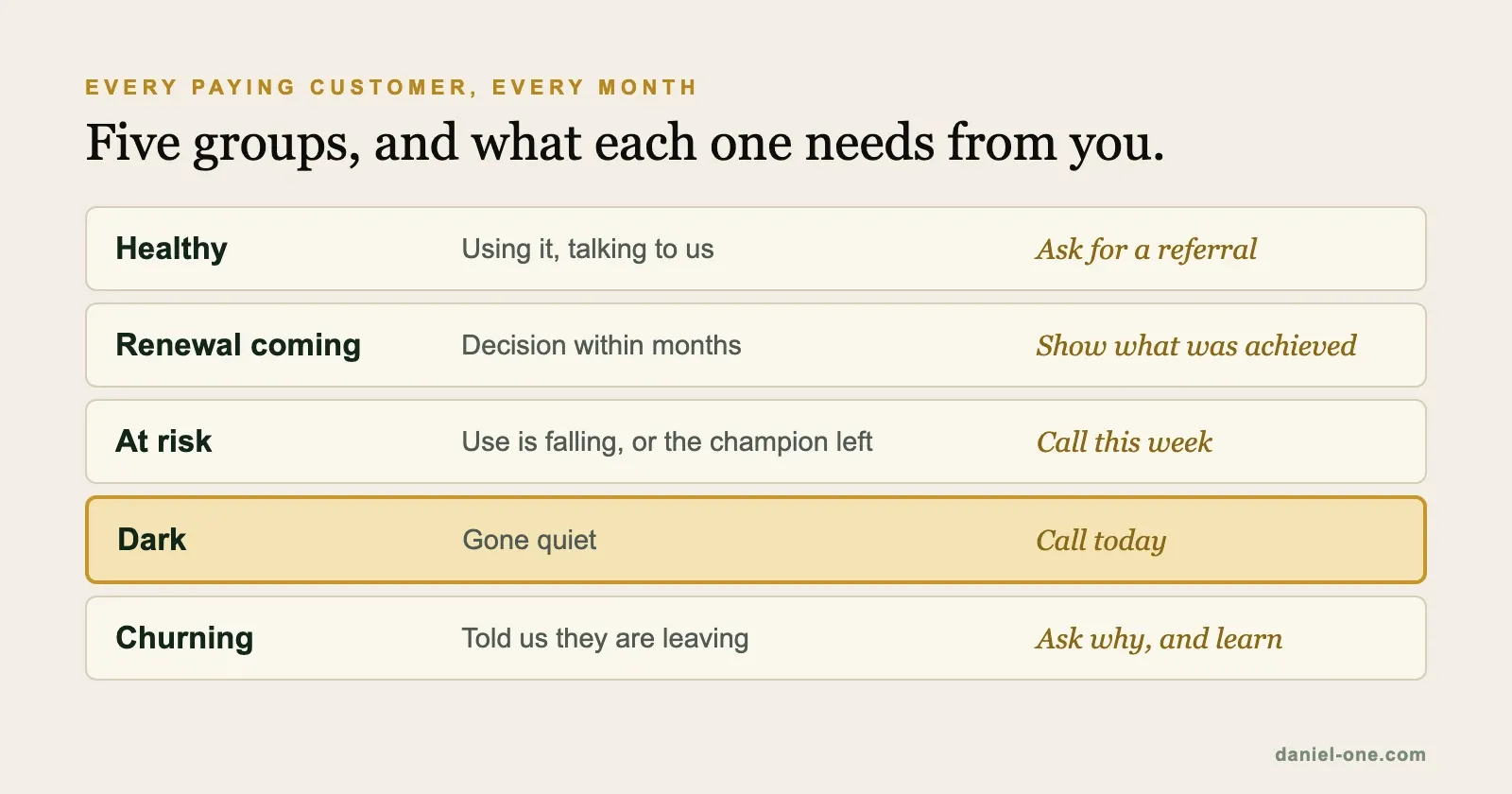
The most useful of these is "dark". A client who has gone quiet is not a happy client who does not need you. Silence is the most common warning sign in B2B, and it is easy to miss because nothing is on fire. Your champion may have left, or the project may have lost its owner. Call them.
You can do this in a spreadsheet. Define your own signs: how often they use what you sell, whether your main contact is still there, whether they answer, when the renewal is, whether anyone has complained.
Step 4: Fix the causes
Now choose what to do, based on the reasons you found. Some typical ones in B2B:
- They never got going. Onboarding is where most clients are really lost. Agree with them what success looks like, and get them to the first useful result as soon as you can.
- Your champion left. Know more than one person at every client. When a new person starts, treat it as a new sale.
- They forgot what you do for them. Show it. A short review once or twice a year, with what has been achieved, is worth a lot at renewal time.
- Nobody owned the relationship. Give every client a named person. In a small company, write down who it is.
- They could not see where the money went. Be clear about costs, process and outcomes.
- You sold to the wrong client. Then the fix is in sales, not in service. Go back to who you say no to.
- You kept doing the same thing. What a client needs changes. Eric Bengtson at Sourcing Allies has worked with us for seven years, and in his words the work has shifted "from generating leads to attracting the right ones".
Make sure there are regular check-ins with open questions, and act on what you hear. Consider Net Promoter Score after a milestone, or a small advisory board with your best clients. The tool matters less than whether anyone responds to what comes in.
Then get help from the people who stay. Happy clients are where your best referrals come from, and there is more on that in how to turn customers into fans.
Step 5: Give them something to tell
Fixing what is broken will stop people leaving, for a while. A client who is merely satisfied still leaves when someone cheaper comes along, and nobody talks about a supplier who was fine. Two stories show what changes that.
In 2010, Will Guidara was running Eleven Madison Park in New York, then one of the best restaurants in the city. One lunchtime he overheard a table of tourists saying they had been to all the great restaurants but had never had a New York street hot dog. He ran out, bought one from the nearest cart and had the kitchen plate it up properly. They told him it was the highlight of their whole trip. He went on to create a job in the restaurant for coming up with ideas like that, and he tells the story in Unreasonable Hospitality. The way he puts it: "I was in the business of serving them memories."
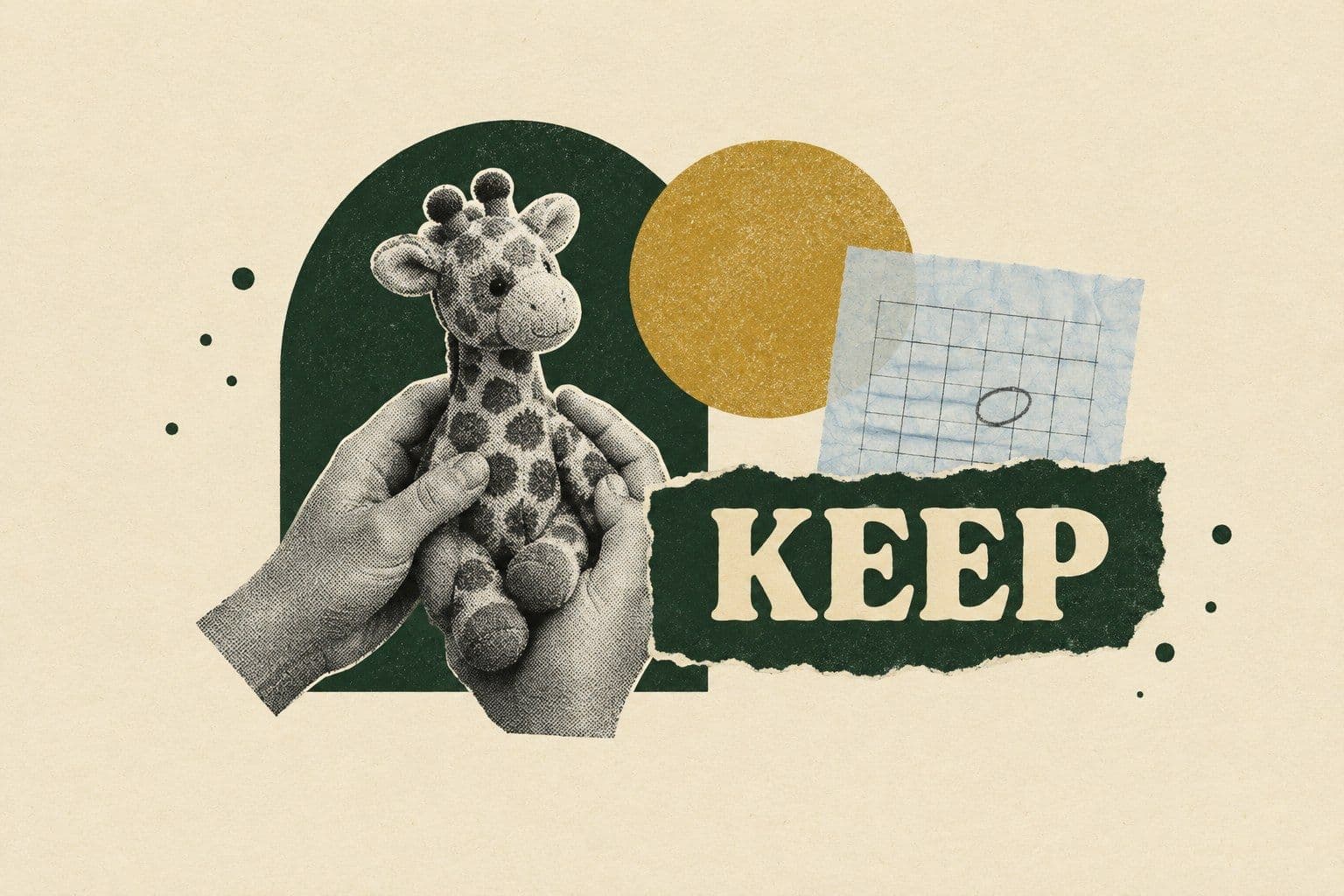
At the Ritz-Carlton on Amelia Island, Chris Hurn's son left his stuffed giraffe behind. To get his son to sleep, Hurn told him that Joshie was having a little extra holiday. Then the hotel called: the giraffe had turned up in the laundry. Hurn asked if someone could possibly take a photo of it by the pool, to back up his story. A few days later a package arrived with Joshie, some gifts and a binder of photographs: Joshie sunbathing by the pool, having a massage in the spa and helping out on the security cameras. Hurn is still telling the story years later, and now you have heard it too.
The hot dog cost about two dollars. The giraffe cost a few hours of someone's time. What made them possible was that someone was listening, and was allowed to act.
In B2B, your hot dog will look different. You notice that your client is presenting to their board next week, and you send them a one-page summary of what has been achieved. Your champion moves to a new company, and you send something useful for their first week. Someone mentions a problem that has nothing to do with what you sell, and you introduce them to a person who can help. Make it somebody's job to notice these things, and tell your team they do not need permission.
Step 6: Write a plan you can follow
Keep it to one page:
- Your churn today, overall and per segment, and what you want it to be
- The three main reasons clients leave
- What you will do about each, who owns it and by when
- How you will measure it: churn, revenue kept, satisfaction
- When you will look at it again
Share it with the team, and go through it every quarter. Everyone should know who owns what.
This is step six in how to win new B2B clients. If you only do one thing this week, list the clients who have gone quiet and call three of them. You will learn more from those calls than from any dashboard.
If clients are leaving and you are not sure why, talk to us at Up Strategy Lab.
Frequently asked questions
How do you calculate customer churn?
Divide the number of clients you lost in a period by the number of clients you had at the start of it, and multiply by 100. If you start the year with 30 clients and lose 5, your annual churn is 16.7%. Leave out new clients won during the period.
What is a good churn rate in B2B?
It varies a lot with client size, contract length and industry, so compare yourself with your own past rather than with a general benchmark. Look at churn per segment and in money. One segment that keeps leaving often tells you more than the overall number.
Why do B2B clients leave?
The most common reasons are that they never got going, their main contact left, they stopped seeing the value, nobody owned the relationship, or they were the wrong client from the start. The reason recorded in the CRM is often not the real one, so call them and ask.
What are the warning signs a client is about to leave?
Silence is the most common. Others are falling use of what you sell, your main contact leaving, slow replies, complaints that have not been resolved and a renewal coming up with no recent conversation.
How do you make clients talk about you?
Fixing problems keeps clients, and doing something unexpected gets them talking. Listen for small things you could do that have nothing to do with the contract, such as preparing a summary before their board meeting or helping with an unrelated problem. Make it someone's job to notice, and let your team act without asking for permission.
How do you reduce churn?
Find out why clients really left, then fix those causes. Typical fixes are better onboarding, a named owner for every client, more than one contact at each client, regular reviews that show what has been achieved, and selling less to the kind of client who keeps leaving.
The Visibility Edge
Tested ideas on building better B2B companies, when there is something worth sending.