
Most marketing plans fail before they are even written. The team sits down, opens a document, and starts listing tactics. Social media. Email. SEO. Maybe some paid ads. They have skipped directly to the how without ever properly answering the where are we now and where do we want to go.
The SOSTAC® model, created by PR Smith, is the most useful antidote to this I have found. It is popular (widely taught, widely referenced) and I think the reason for that is not just that it is simple and logical, but that it is honest about where planning actually breaks down. I use it a lot, and I think it offers a near-perfect approach for anyone building a marketing or business plan from scratch.
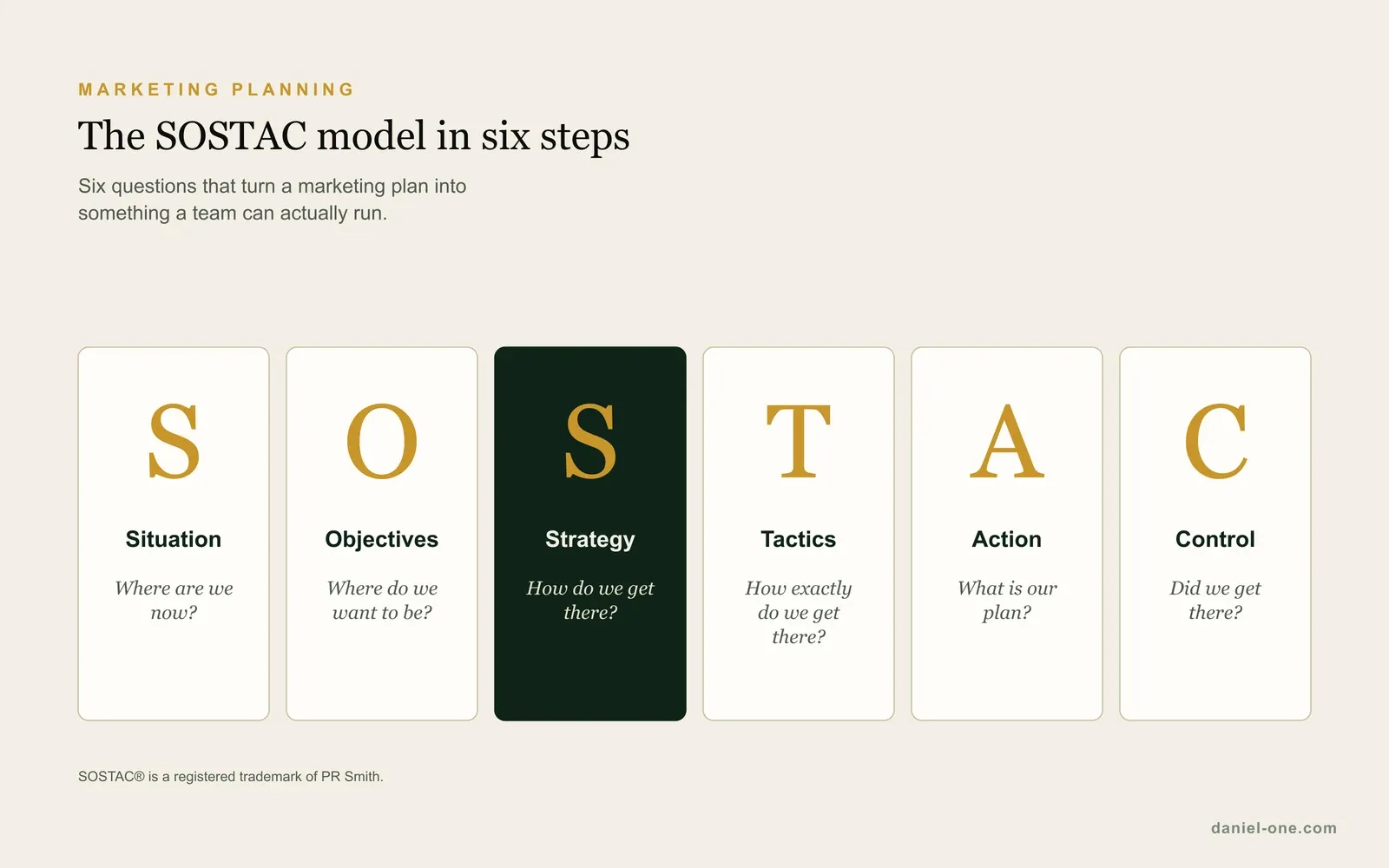
SOSTAC® stands for:
- Situation: where are we now?
- Objectives: where do we want to be?
- Strategy: how do we get there?
- Tactics: how exactly do we get there?
- Action: what is our plan?
- Control: did we get there?
The model offers a logical order for tackling a plan, and you can use it to assess your current processes critically. Do not let the simplicity of the acronym mislead you. Once you unpack each stage, you will see that it requires a considerable amount of time, effort, and data to do well. The reward for that effort is a plan that has a real chance of being executed, not just a document that gets filed after the strategy meeting.
SOSTAC® is a registered trademark of PR Smith. For more on SOSTAC® planning and becoming a SOSTAC® Certified Planner, visit sostac.org.
The trap most companies fall into
The companies I have seen get the most from this framework are the ones who spend three times longer on Situation and Strategy than they think they need to. That pattern holds across very different scales of business and engagement.
The pull toward Tactics is strong because Tactics feels like progress. Writing a content calendar or briefing a campaign feels productive. Sitting in a room doing a proper situation analysis does not. But when the first two stages are done properly, the rest of the plan tends to write itself. When they are rushed, you end up with execution that looks coherent on a spreadsheet and produces nothing in the market.
PR Smith has noted that Strategy is one of the more difficult parts of the SOSTAC plan. I would add that Situation is the one most likely to be treated as a formality. Both deserve more time than most teams give them.
Situation: where are we now?
A SOSTAC situation analysis is an honest overview of where your business stands right now. It is not an exercise in confirmation. It is a method for finding out what you do not yet know about your customers, your market, and the environment you operate in. Without it, every decision you make in the rest of the plan is based on assumption. There are many different tools to help you do this type of analysis. My favourite is the Business Model Canvas from Strategyzer. This tool is free and contains really good questions that you can ask to better understand the situation.
Here are the components I work through:
a. Customer analysis
If you do not know who your customers are or what they actually want, you cannot offer them products or services that meet their needs or add value. A customer analysis gives you a clear picture of who you are really serving, which then tells you which segment to target in your marketing plan.
At a minimum, you need to know: who they are demographically, where they are located, how they found you, how they buy from you, what perceptions they have of your brand, how they interact with you day to day, and what they think of your competitors. These are not questions you can answer from inside the business. You need to go and ask.
To go deeper on this, my guide to customer profiles and buyer personas covers the tools and process I use in practice.
b. Product analysis
Evaluate your product or service in terms of how it actually delivers value to your customers. What you are looking for here is a product-market fit perspective: does what you offer genuinely solve the problem your customer is trying to solve, and does it solve it better than the alternatives? The Value Proposition Canvas is the tool I use for this, and I have written about it in detail in the B2B value proposition guide.
c. Competitor analysis
Who are your real competitors? Not just the obvious ones: the ones competing for the same budget, the same attention, the same decision. Where do they have a competitive advantage over you in terms of price, reputation, customer service, and scale? And where do you have an advantage over them? The goal of this analysis is not to copy your competitors or to beat them at everything. It is to find the ground they are not standing on and own it.
d. The environment you operate in
These are the external factors that will affect your plan whether you account for them or not: economic conditions, political changes, social trends, technological developments, environmental pressures. A good situation analysis names the most relevant of these and makes an honest assessment of their likely impact on your business.
e. SWOT analysis
Once you have done the work above, you can do a meaningful SWOT, looking at the strengths, weaknesses, opportunities, and threats that bear on your business. Strengths and weaknesses are internal: the capabilities, resources, and limitations inside the organisation. Opportunities and threats come from the external environment you just mapped. A SWOT built from real analysis is a useful synthesis. A SWOT built in a two-hour workshop without prior research is just a list of opinions dressed up as insight.
The most common mistake at this stage: Treating the situation analysis as a formality that earns the right to get to the interesting part. Teams rush through it because they think they already know the answers. They almost never do, or they know the answers to the wrong questions.
Objectives: where do we want to be?
Once you understand the situation, you can set meaningful objectives. Not before. An objective that is not grounded in a real understanding of the current situation is a wish, not a target.
PR Smith's 5S framework gives a useful structure for setting balanced objectives that go beyond pure sales targets. The five categories are:
- Sell: grow sales and market share
- Serve: add value to what you offer customers
- Sizzle: create stickiness and a wow factor that differentiates the brand
- Speak: build two-way communication with customers
- Save: achieve quantified efficiency gains
Each objective must be SMART (Specific, Measurable, Achievable, Relevant, Time-bound) to be worth anything as a planning target. Here is what that looks like in practice for the first 5S goal:
Sell: Increase sales by 10% by the end of next quarter.
That is an objective. "Grow the business" is not.
The 5S framework is useful because it forces you to set objectives across dimensions that pure revenue targets ignore. Serve, Sizzle, and Speak push you to think about what your customers actually experience, which is where the long-term commercial value in a B2B business tends to live. A company that hits its Sell number while letting its Serve and Speak numbers slide is borrowing from its future.
The most common mistake at this stage: Setting objectives that look SMART on paper but are not actually measurable in practice, or setting objectives in the planning meeting and never revisiting whether the strategy that follows can plausibly deliver them. Objectives and strategy need to be in conversation with each other. If the strategy cannot deliver the objective, one of them needs to change.
Strategy: how do we get there?
Strategy is the big picture of how you plan to achieve the objectives you have set. It is also, as PR Smith notes, one of the more difficult parts of the SOSTAC plan, because it requires making explicit choices about who you are for, how you are different, and where you will compete. Most companies avoid making these choices explicitly and wonder later why the tactics are not working.
PR Smith recommends STP (Segmentation, Targeting, and Positioning) as the strategic tool for this stage.
Segmentation means dividing your potential market into groups with meaningfully different characteristics. The basis can be demographic (age, company size, industry, geography) or behavioural (how they buy, what they value, what triggers a purchase). The discipline is that each segment should respond differently to your offering: if they would all respond the same way, you have not segmented the market, you have just categorised it. Segmentation is also useful because it surfaces potential customers you may not have thought of: groups with specific needs that your product serves well but that you have never spoken to directly.
Targeting means choosing which of those segments to focus on. Not all segments are equally valuable: some are too small, too expensive to reach, or too competitive. The segments worth pursuing are those where you have a genuine advantage, where the return justifies the cost, and where you can credibly deliver on the promise you are making.
Positioning means deciding how you want your offering to be perceived by each target segment, relative to the alternatives available to them. Positioning is not a tagline or a brand colour. It is the substance of your competitive claim: the specific reason why this customer, given these alternatives, should choose you.
When we worked with CapillaryFlow on their rebrand and multi-vertical go-to-market strategy, the STP work was the foundation of everything that followed. The company had a strong position in golf, but the strategy work revealed that the same patented technology applied cleanly to equestrian, sports fields, and urban leisure, each a meaningfully different segment with different buyers, different messages, and different sales materials. Without doing the segmentation and targeting work properly, those markets would have stayed invisible. Direct sales leads in the equestrian segment grew 777% year-on-year once the strategy was in place.
The most common mistake at this stage: Writing a channel list and calling it a strategy. "We will do LinkedIn and content marketing" is not a strategy. It is a tactics note. Strategy comes before channels: it determines which channels make sense, not the other way around.
SOSTAC in practice: what it looks like when it works
When we worked with Optimal Kommunikation, a Swedish direct marketing company, the commercial problem was not their service. It was visibility and clarity: the market could not see what they did or why it mattered. Their website was unclear. Their positioning was vague. Inbound leads were thin and poorly qualified.
The work followed the same diagnostic sequence SOSTAC describes. The situation analysis revealed a gap between how the company described itself and what its best customers actually valued. The customer segment most worth targeting became clear only once that analysis was done. It was not what the team had assumed going in. From there, the strategy (which segments to prioritise, how to position the company, how to structure the website) followed from the data rather than from instinct.
The results over the following years: Net sales more than doubled, from SEK 53 million to SEK 124 million between 2020 and 2024. The company now generates 70 to 90 high-quality leads a month.
The same model, the same market, the same service, but with genuine clarity about who they were for and what they were offering.
Tactics: how exactly do we get there?
Tactics covers the detail of how you will deliver your strategy. In the context of digital marketing, this means making decisions about what data you have on your customers and what you still need, which methods you will use to reach them, and what your communications and channel mix looks like across the plan.
The specific questions to work through:
- What customer data do you already have, and what are you missing that would change your decisions?
- Which channels will you use to reach your target segments: advertising, email, content marketing, SEO, social media, events, partnerships? And which will you deliberately not use?
- What does your digital mix look like, and how do the channels work together rather than independently?
- What content and campaigns will carry the strategy, and in what sequence?
- What is the timeline for rollout?
The discipline at this stage is staying tethered to the strategy. Every tactic should have a clear line back to a segment, a positioning decision, and an objective. If a channel or campaign cannot be traced back to those three things, it is activity, not tactics.
A practical note: the tactical mix for a B2B company with a six-month sales cycle looks very different from one selling a high-volume, low-consideration product. Build for your buyers, not for what your competitors are doing or what your team is most comfortable executing.
The most common mistake at this stage: Choosing tactics before the strategy is solid, which is almost always a symptom of rushing the Strategy stage. When this happens, you end up with a channel plan that looks busy on a spreadsheet but has no strategic logic underneath it. Six months in, nobody can explain why the results are not there.
Action: what is our plan?
Action is where the strategy and tactics get turned into an actual operational plan: who does what, by when, with what resources and budget.
PR Smith is direct about this stage often being treated as an afterthought, and that is exactly right in my experience. Teams invest significant energy in the strategy and tactics, then write a vague action section that assigns work to job titles rather than people and sets milestones without owners. The result is a plan that cannot be executed because nobody knows who is accountable for starting.
The questions that need answering here:
- Do you have the human resources internally to execute this plan, or do you need to hire?
- Do you need external agencies, consultants, or partners, and are those relationships already in place?
- Do you have the systems and processes the plan depends on (the CRM, the analytics setup, the content workflow) or do you need to build them first?
- Who owns each workstream, by name and not by function?
- What are the 90-day milestones, and who is accountable for each one?
A SOSTAC plan with a weak Action section is a strategy document, not a plan. The difference is whether execution can actually begin when the meeting ends.
The most common mistake at this stage: Assigning ownership to teams rather than individuals. "Marketing will handle content" is not an action. "Anna publishes two articles per month from the approved content calendar, starting the first Monday of June" is an action.
Control: did we get there?
Control is the monitoring and measurement system you put in place to know whether the plan is working, and to give you the information to adjust it while there is still time.
This means deciding, before execution begins, exactly how you will track progress. The tools available are familiar: web analytics, KPIs, site visitor profiles and behaviour data, usability testing, customer satisfaction surveys. What you use matters less than the discipline of the review cadence and the reporting structure: who reports to whom, how often, and what happens to that feedback.
The practical decisions to make:
- Which metrics genuinely tell you whether the plan is on track, and can you keep that list to three to five numbers?
- How often will you review: daily, weekly, monthly, quarterly? Different parts of the plan may need different cadences.
- What does a result look like that should trigger a change in direction, not just a note in a report, but an actual decision to adjust?
A monthly review that actually happens and produces a decision is worth more than a sophisticated analytics setup that nobody looks at between quarterly board meetings.
The most common mistake at this stage: Measuring everything and acting on nothing. When the metrics list is too long, there is no signal, just noise. Pick the numbers that would tell you unambiguously whether the plan is working, report on those consistently, and make sure someone in the room has the authority to change course when the numbers say to.
SOSTAC and the RACE framework
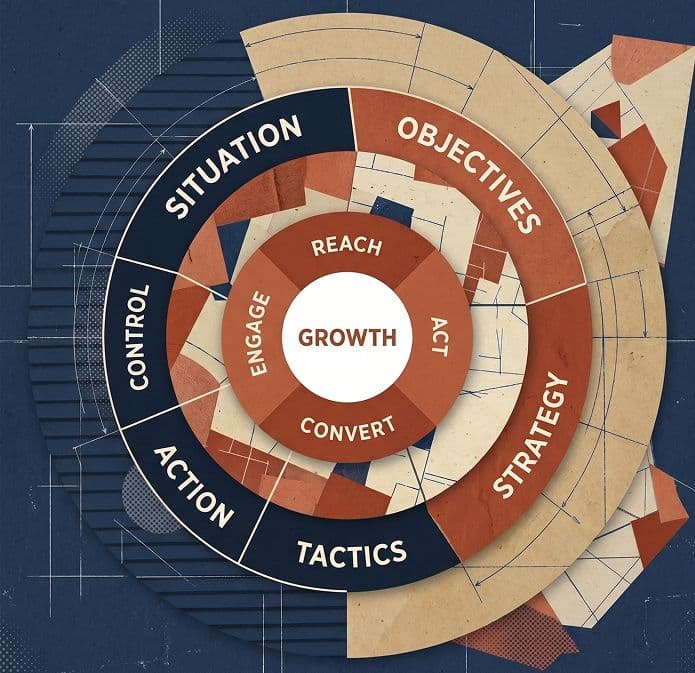
If you have come across SOSTAC in the context of integrated marketing communications, you have probably also encountered RACE (Plan, Reach, Act, Convert, Engage), a framework developed by Smart Insights. The two complement each other rather than compete.
SOSTAC is a planning model: it gives you the structure for building the full strategy and operational plan. RACE is a customer lifecycle model: it maps the stages a customer moves through from first awareness to long-term engagement and advocacy. Used together, SOSTAC gives you the strategic foundation and RACE gives you a framework for organising your tactics and metrics around how customers actually move through a buying journey. Most digital marketing plans that use one can be sharpened by applying the other.
I have used this across 20 years of building B2B companies
The SOSTAC model shows up everywhere in the work I do, across the companies I have built and the clients I have worked with. Whether it is a direct marketing company rethinking its digital presence, a technology company entering new verticals, or a startup defining its go-to-market for the first time, the sequence is always the same: understand the situation properly before you set objectives, build the strategy before you choose the tactics.
I have written guides covering most of the tools that sit inside this framework: the value proposition work, the sales process design, the customer segmentation. They all connect.
Download the SOSTAC® Planning Template
I have put together a two-page planning template that walks through all six SOSTAC stages: the key questions to answer at each step, the most common mistake to avoid, and space to work through your own plan. It is the structure I use before any tactical work begins.
Download the SOSTAC® Planning Template: free, no email required →
If the Strategy step is where your plan usually stalls
Most marketing plans I see have a reasonable situation analysis and a clear enough set of objectives. What they are missing is the strategy that connects the two: the explicit choices about which segments to prioritise, how to position against the real alternatives, and where not to compete.
That is the step where an outside perspective tends to make the most difference. If you are building a marketing plan and want a second pair of eyes on the Strategy before you commit to execution, that is exactly the kind of work we do at Up Strategy Lab. The /work-with-daniel page explains what that looks like.
Related reading: How to create a strong B2B value proposition · How to design a B2B sales process
SOSTAC® is a registered trademark of PR Smith. For more information on SOSTAC® Planning & becoming a SOSTAC® Certified Planner visit www.SOSTAC.org
Download my tools
I have also put together my core planning tools as four free playbooks: Customer Profile, Value Proposition, Sales Process and Partner Programme. Download them and use them with your team.
Frequently asked questions
What does SOSTAC stand for?
SOSTAC stands for Situation, Objectives, Strategy, Tactics, Action, and Control. It is a marketing and business planning framework created by PR Smith. Each letter represents a stage in the planning process: Situation asks where you are now, Objectives asks where you want to be, Strategy asks how you will get there, Tactics asks how exactly you will get there, Action asks who does what, and Control asks how you will know whether the plan is working. SOSTAC® is a registered trademark of PR Smith.
How do you use the SOSTAC model for digital marketing?
Work through each stage in sequence. Start with a situation analysis: audit your digital presence, traffic sources, customer segments, and competitive landscape. Set objectives using the 5S goals (Sell, Serve, Sizzle, Speak, Save) and make each one SMART. Build your strategy using STP: segment your audience, decide which segments to target, and define how you will position your offering for each. Tactics covers the specific channels and campaigns (SEO, paid search, content, email, social) and how they work together. Action defines who does what and by when. Control puts the measurement systems in place. The most important discipline throughout is spending enough time on Situation and Strategy before you touch Tactics.
What is the difference between SOSTAC Strategy and Tactics?
Strategy is the big picture: which customer segments you are targeting, how you will position your offering against competitors, and where you will compete, and where you will not. Tactics is the execution detail: which specific channels, campaigns, and tools you will use to deliver that strategy. The most common mistake in SOSTAC planning is treating these two as one: jumping from objectives straight to tactics without building the strategic foundation. When that happens, execution becomes activity without direction.
What are the 5S objectives in the SOSTAC model?
The 5S objectives are: Sell (grow sales and market share), Serve (add value to what you offer customers), Sizzle (create stickiness and a wow factor that differentiates the brand), Speak (build two-way communication with customers), and Save (achieve quantified efficiency gains). Each should be made SMART: Specific, Measurable, Achievable, Relevant, and Time-bound. A worked example for the Sell goal: "Increase sales by 10% by the end of next quarter." Vague objectives are wishes, not targets.
Is SOSTAC still relevant in 2026?
Yes. The framework holds up because its underlying logic is durable: the discipline of diagnosing before planning, and planning before executing, does not change with the platforms. What dates in a SOSTAC plan is the Tactics step: the specific channels and tools evolve constantly. But the framework that tells you to understand your situation before setting objectives, and to build your strategy before choosing your tactics, is as useful now as it was when PR Smith first published it.
The Visibility Edge
Tested ideas on building better B2B companies, when there is something worth sending.