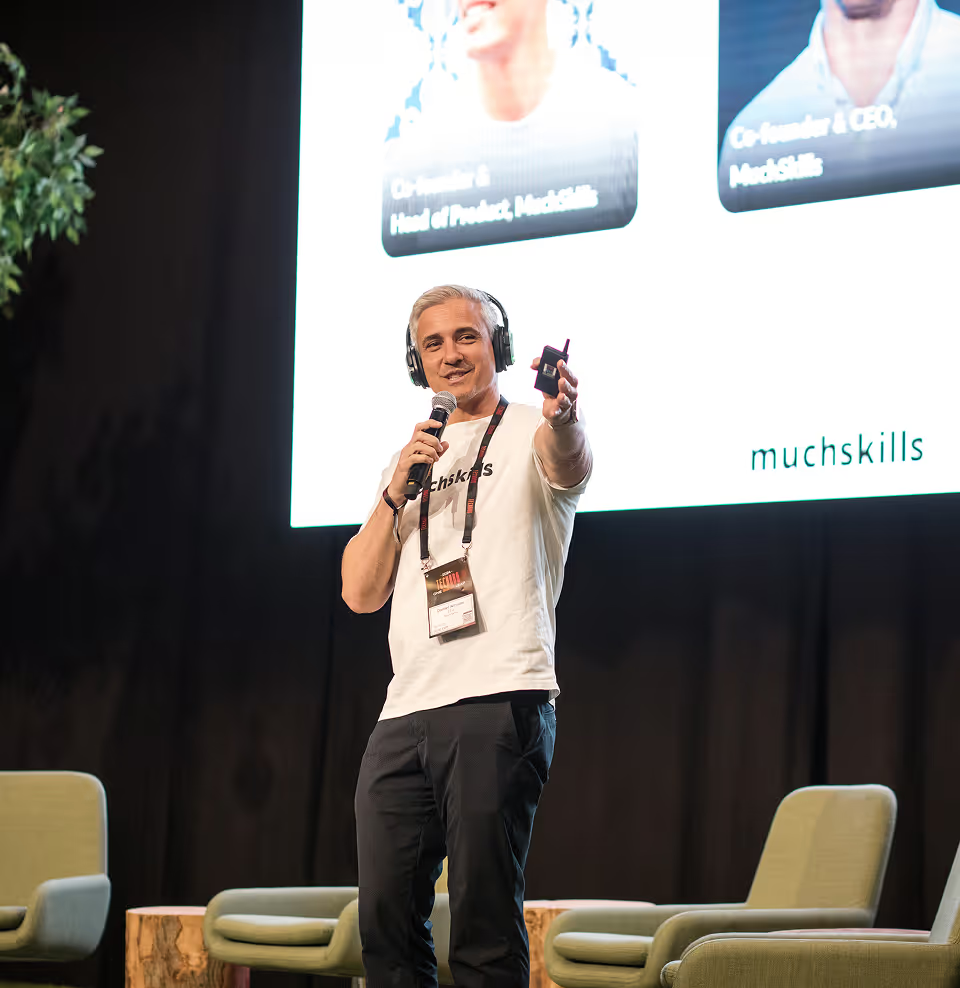
"Most B2B growth problems are
visibility problems."
The Visibility Problem · daniel-one.com
The Visibility Problem
Why most B2B companies get stuck, and why the fix is almost never what founders think it is.
In 2003 I joined a small IT security company in Gothenburg called Cryptzone. We had no customers, no revenue, and almost no employees. Nine years later I left a business with 61 people, €6.5 million in annual revenue, and 850 customers in 34 countries. Our biggest market was the United States.
The journey taught me a lot of things, but the one I think about most is this: At every single point we got stuck, the problem was visibility.
Not the product, the price, the technology, or the market. Visibility.
In the first two years, buyers could not find us. Our website did not rank for anything useful. The positioning was written in jargon. The handful of people who did land on the homepage could not tell what we did in the first five seconds. We spent months rewriting the same pages over and over, not because the old copy was wrong, but because no one could see the company through it.
A few years later we hit a wall of a different shape. The product had grown, and the team had grown with it. And we started hiring for skills we already had inside the building. Managers did not know what their own people could do. We were paying premium recruitment fees for capabilities that were sitting three desks away, quiet, unnoticed, ready to go. This was a visibility problem of a different kind.
Then, when we tried to scale internationally, the hardest version of all hit us. We could not see the commercial system. We did not know which partners were actually working, which geographies were actually returning, which campaigns were actually pulling buyers in. Everything felt like a guess. We doubled down on things that were not moving, and ignored things that were about to. This was the most expensive visibility problem of all.
I have spent the twenty-three years since then working with B2B companies as a marketer, a chief commercial officer, a studio co-founder, and a product builder. In almost every engagement, when a B2B company is stuck, the real problem is visibility.
Not always the same kind. But always visibility.
It usually shows up as one of three.
01
Product visibility
The buyer cannot see what the company does, or what makes it different, or why it is worth a meeting.
The website was built by an agency that did not understand the business. The positioning is fuzzy. The technical complexity that makes the product valuable is the same complexity that makes it illegible. Good buyers leave in under five seconds.
The company blames the product, or the sales team, or the market. The actual problem is that nobody can see the product clearly enough to want it.
I see this most often in technically excellent companies. Engineering-led founders. Deep IP. Real customers who already love the thing. And a website that makes a serious buyer click straight back to Google.
02
People visibility
The company has already hired the people it needs, but the managers cannot see who is good at what.
Skills are locked in CVs that nobody reads and memories that nobody shares. Projects get staffed wrong. Growth is slower than it should be. The best people get bored and leave. Training budgets get spent on things the team already knows.
The inventory of capability is invisible.
This is the version Noel saw years before we met. He was running a creative team at a previous studio, watching colleagues hire freelancers for work that someone in the room next door had already done five times. He built a simple Google Sheet to fix it, just for his own team. It worked. He kept iterating on it. By the time he and I met, that sheet had become a small obsession of his.
Years later, after we co-founded Up Strategy Lab and started running B2B engagements together, we kept seeing exactly the same problem in client after client. Nobody could see what their own people could do. We turned Noel's obsession into a real product. That is how MuchSkills started. Today it is used by more than 100,000 professionals, has won a Red Dot Design Award, and was named a Major Contender in the Everest Group PEAK Matrix® for skills intelligence in 2026.
The proof I care about is simpler than the awards. Managers stop hiring blind. Teams find each other. Work gets faster.
03
Commercial visibility
The founder cannot see the system.
They know revenue. They know the pipeline number from the last board meeting. They know which deals are loud right now. But they cannot see which partners are actually working and which are dead, which customer profiles are converting and which are wasting sales hours, which campaigns are compounding and which are vanity.
So they make decisions on whichever signal is loudest, not whichever signal is most accurate. They double down on noise. They quietly defund the things that were about to work.
I have done every one of these. So have most founders I respect.
The thing that makes the visibility problem so hard to solve is that it does not feel like a visibility problem when you are inside it.
It feels like a product problem. Or a people problem. Or a market problem. Founders rebuild products that did not need rebuilding. They hire headcount they did not need to hire. They give up on markets they did not need to give up on.
Most of the wasted years I can remember in my own career came from trying to fix the wrong layer.
Here is the test I now use when a founder tells me they are stuck.
I ask them to open a laptop and show me, in real time, three things.
One: What their best buyer sees when they land on the homepage for the first time.
Two: A list of every capability inside their team right now, ranked by how confident each person is in it.
Three: Which of their last ten commercial decisions actually moved revenue, and which did not.
Almost nobody can show me all three. Most people cannot show me any of them without a long silence first.
And this is why I believe visibility is not a marketing concern, or an HR concern, or a data concern. It is the precondition for every other move the company wants to make. A company that cannot see its product, its people, or its commercial system cannot grow. It can hustle, hire, and burn money. But it cannot grow in the way a serious founder means when they say the word.
A note on grit
I have more grit than almost anyone I know. I have started companies in rooms with no chairs and no plan, I've flown to countries I had never been to before in order to close customers. I have also been the person who keeps going when nobody else in the team thinks the thing will work.
Grit is a real asset, and I would not trade mine for anything.
But here is what I have learned the hard way. Grit without visibility is the most expensive thing a founder can have. You can run very fast, for very long, in the wrong direction, on real conviction. I have done it more than once.
Grit plus visibility is how companies actually compound. One without the other is wasted. Together, they are how a small company turns into a serious one.
The good news
Visibility is easily fixable because it is a clarity problem. And clarity can be built. It just has to be pursued with rigour.
This is what I spend my life doing now.
Up Strategy Lab, the studio Noel Braganza and I co-founded, exists to make B2B companies and their products visible. We do strategy, brand, design, and product work for founders with complex offers that most agencies cannot handle.
The work looks like this in practice:
A patented water management business serving golf, equestrian, and urban leisure that we rebranded from Capillary Concrete into CapillaryFlow, then helped to triple inbound leads in their newest segment in a single year.
A world leader in radiation-hardened microprocessors whose chips power missions across the solar system, where our job was to make the depth of the technology legible to a serious aerospace and defence buyer without dumbing any of it down.
An AI predictive maintenance company monitoring fleets of industrial assets, where the redesigned product is now described publicly by its own users as a fully reimagined platform.
Each of these companies had a real product and a real audience and a website that was getting in the way. Each one sold more, and sold to better buyers, after we made them visible.
MuchSkills, the product we built inside the studio, exists to make people and their skills visible. It is used by Accenture, Red Hat, and organisations across six regions. Customers do not buy it because it is clever software. They buy it because, when they switch it on, they can finally see the team they already had.
And The Visibility Edge, the newsletter you are one click away from subscribing to, is where I think out loud about all of this when I have something tested and worth sharing.
If you are a founder reading this and something landed, I would ask you to do one thing before you close this tab.
Write down the last time your company got stuck. Then ask yourself, honestly, whether the real problem was the product, or the people, or the market. Or whether, underneath that, the real problem was that something important inside your business had gone invisible.
It almost always has. And the founders who see it clearly – who can name which layer has gone invisible and why – are the ones who stop wasting years on the wrong fix.
I'm Daniel Nilsson – CEO of MuchSkills and co-founder of Up Strategy Lab. I write about visibility, B2B growth, and what it actually takes to build a serious company at daniel-one.com. If something in this essay landed, The Visibility Edge is where the rest of it goes.
"Grit without visibility is the most expensive thing a founder can have."
The Visibility Edge

A note on grit.
Grit plus visibility is how companies actually compound. One without the other is wasted.