Most B2B companies think they know their customer. Almost none know them as well as they think.
In 2013, I started at Mentice, a company that designs medical simulation software and hardware for endovascular procedures. Three things were immediately clear. I had never worked in healthcare. The vertical was heavily regulated. And I had no idea what endovascular even meant.
My colleagues explained it: endovascular surgery is when you operate inside the blood vessels. The approach lets you reach almost any part of the body, from the toes to the heart to the brain, without major open surgery. The technology saves lives. Mentice built the simulation systems that let physicians practise and improve their skills before performing those procedures on real patients.
What I quickly discovered was that Mentice did not have one customer. It had two entirely different ones.
The first was medical training centres connected to hospitals, where the buyers were training managers and the end users were the physicians themselves. The second was the medical device industry: large companies inventing new products and procedures, who needed Mentice to build a marketing tool for a new technique or an education concept around a new device. In those companies, the Mentice contact could sit in education, marketing, sales, or product development, all with different objectives and different ways of measuring success.
Two completely different customer groups. One corporate website. One front page that could only tell one story.
My CEO told me when I started that it took him five years before he truly understood the business. I had the same problem in front of me, and I needed to solve it faster than that.
That experience is why I believe so strongly in building customer profiles before doing almost anything else in B2B. Not because it is best practice. Because without them, you end up writing messages that are halfway between two different buyers and convincing neither.
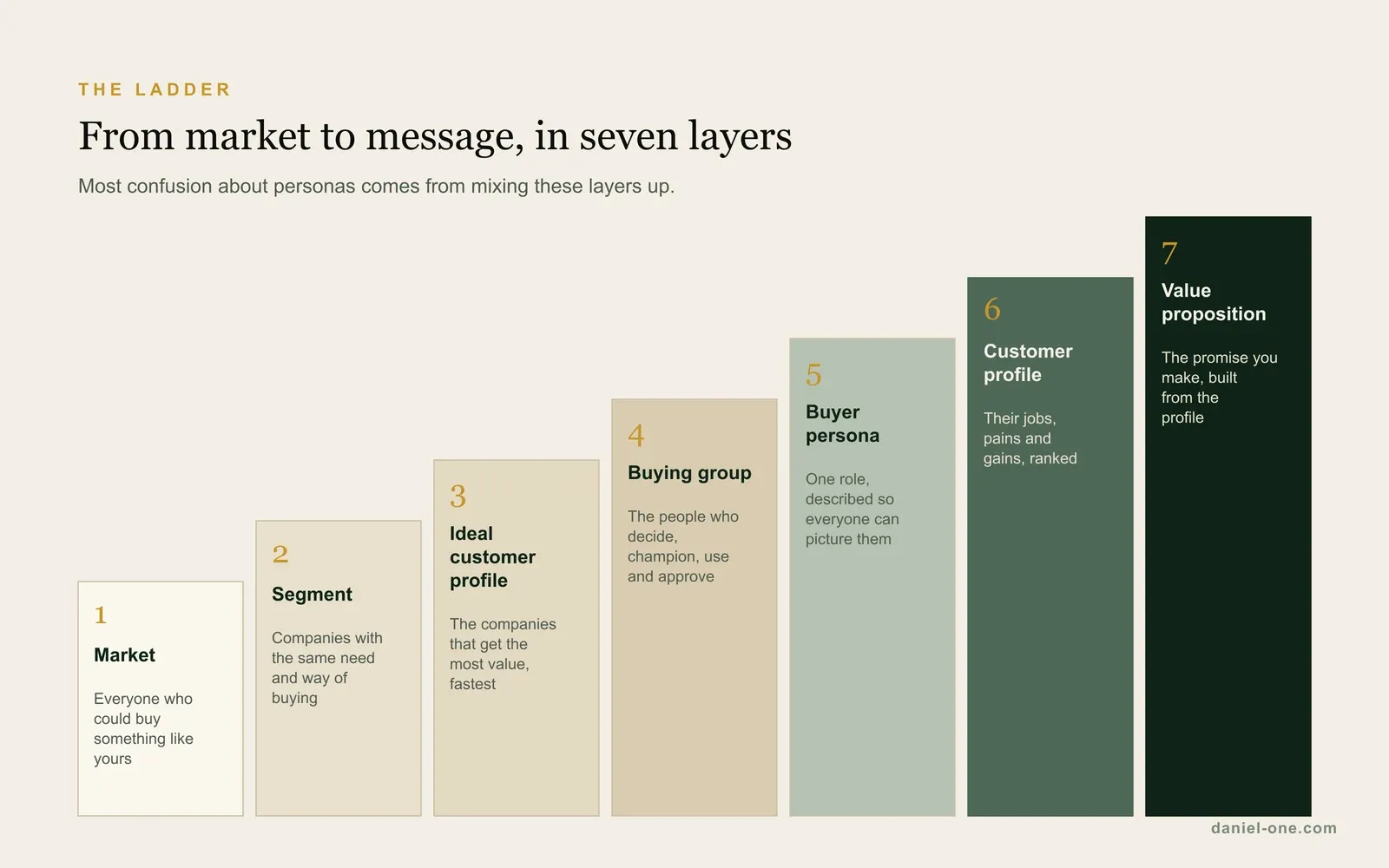
In short: A customer profile describes what one type of buyer is trying to get done, what they fear and what they hope for, ranked by what matters most to them. A buyer persona turns that profile into a person your whole team can picture.
First, a distinction worth making
Before we go further: a customer profile and an ideal customer profile are different things, and confusing them is expensive.
Your ideal customer profile (ICP) describes the type of company you should target: the industry, the size, the situation, the signals that indicate they are ready to buy. It is a segment-level description.
Your buyer persona describes the individual people inside those companies who shape the purchase decision: their role, their daily frustrations, the outcomes they are trying to create, the risks they are trying to avoid.
Both matter. They do different work. This page covers the persona level: understanding the individual. For the company-level work of defining and refining your ICP, see the section below: Start with evidence, then choose where to focus.
Why most customer profiles are wrong
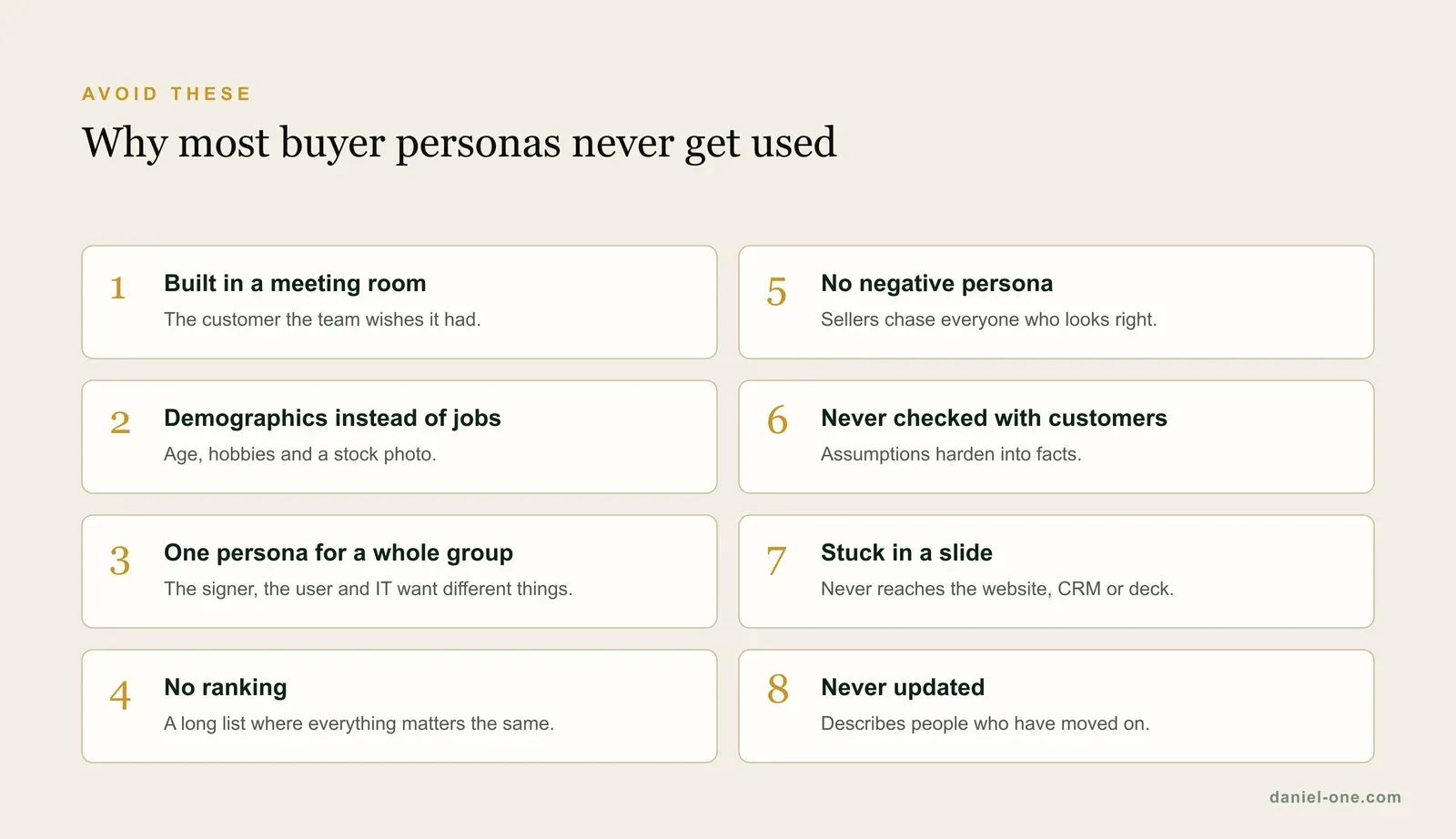
The most common way companies build customer profiles is in a meeting room with a whiteboard and a group of people who sell the product. The result is a profile that describes the customer the team wishes it had, filtered through the experiences of the people in that room.
That profile is almost always wrong in the same ways. It underestimates how much the customer is already trying to solve the problem themselves. It overestimates how central your product is to their working day. And it misses entirely the things the customer finds frustrating about products like yours, because none of the people in the room have ever been on the other side of the sale.
The only way to build an accurate customer profile is to get the information from customers. Not hypothetical customers. Real ones.
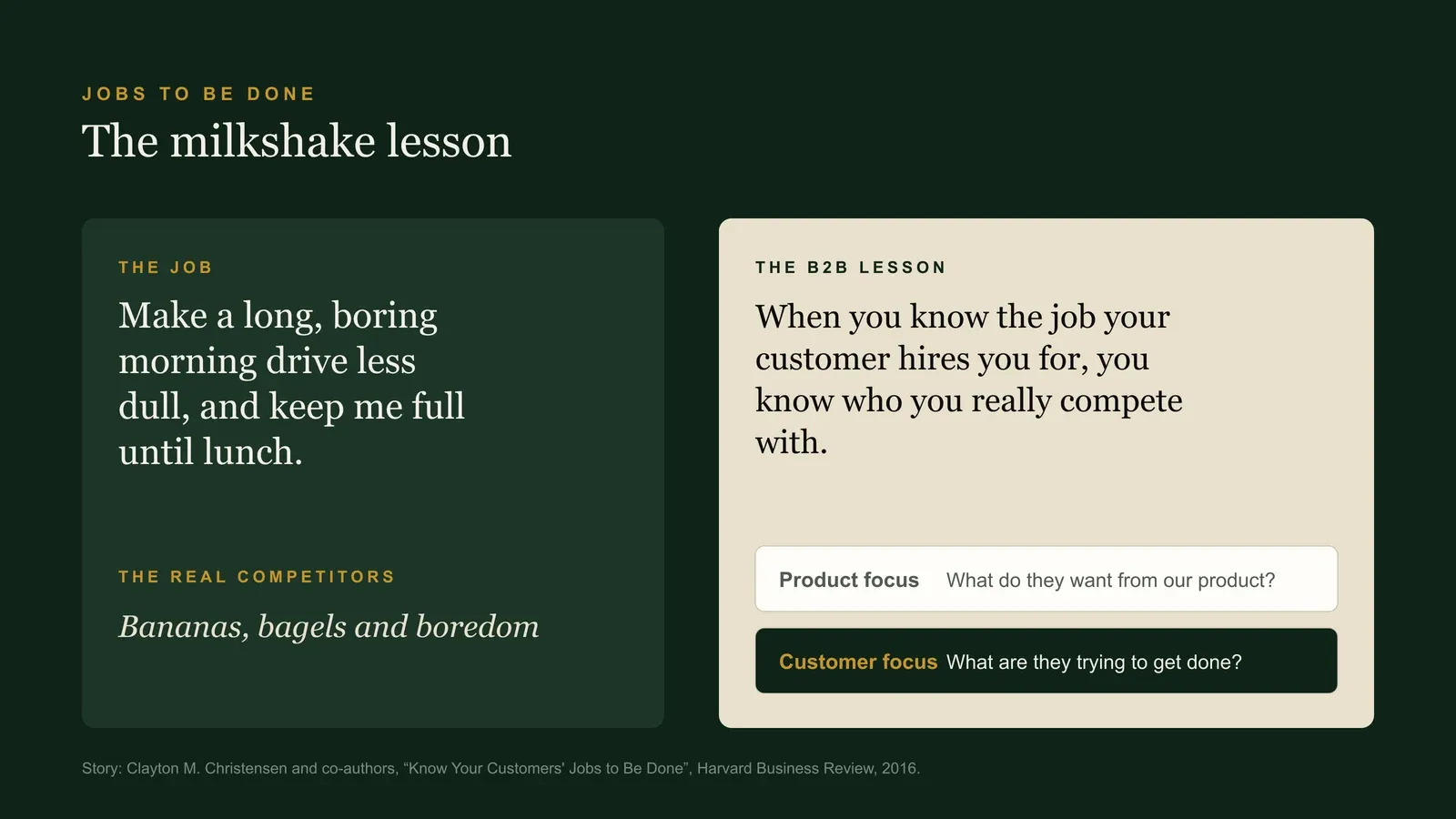
A fast-food chain wanted to sell more milkshakes, so it asked customers how to improve them and changed the recipe, but sales did not move. Then researchers watched who bought milkshakes and when. Many were bought early in the morning by commuters who hired the milkshake to make a long, boring drive less dull and to keep them full until lunch.
The story is from Clayton M. Christensen and co-authors, "Know Your Customers' Jobs to Be Done", Harvard Business Review, 2016. Watch Christensen tell it.
At Mentice, I took five steps to close the gap between what we assumed about our customers and what was actually true.
The five steps I took at Mentice
Step 1: I interviewed customers directly. I used Alexander Osterwalder's Value Proposition Designer as my framework and interviewed key people across both customer groups. I never assumed who the customer was. I went in with open questions about jobs, pains, and gains. Each interview ran for about two hours. Afterwards, I compiled the data first per person and then as a combined report, sorting everything into multiple key value propositions. The interviews gave me a base I could not have constructed any other way.
Step 2: I learned the product from the inside. As I understood the business better, I noticed that the support and service function needed attention. Customers could only get help during business hours, and only if they called the right person directly. I helped Mentice set up a support portal with articles, manuals, and educational videos. By 2015, the portal had over 4,800 visitors. The unexpected benefit was that customers began to understand how to get more from the system, and that led directly to better conversations about value.
Step 3: I went to conferences and met customers in person. My most useful insights have always come from conversations in the margins: standing at a booth, attending a customer event, being in the room when someone says something offhand. At one conference, a customer mentioned they were trying to build a curriculum for the simulator. That single remark turned into a whitepaper on how to create curricula for healthcare simulation, which generated a stream of leads and helped customers build better training programmes. You cannot manufacture that kind of insight from a boardroom.
Step 4: I ran workshops. After about eighteen months, I had enough understanding to facilitate properly. I ran a two-day workshop covering business model canvas and value proposition work, this time focused on specific target customer groups rather than the business as a whole. The result was a much more precise picture of the jobs, pains, and gains for each segment.
Step 5: I kept talking until the idea arrived. There was no single moment. It built slowly. I kept asking the same question: what do all Mentice customers have in common? The hospitals, the physicians, the trainers, the medical device companies: what connects them? The answer emerged at a conference, mid-conversation at the Mentice booth. All of them, regardless of their role or organisation, shared the same underlying goal: to save lives and reduce suffering. That was the thread. From there, the positioning followed.
The core value proposition became "Achieving Endovascular Excellence." The tagline: "We passionately support our customers' mission to save lives." I wanted to build the feeling that Mentice was a community for the people who believed that greater skill leads to better outcomes for patients, and to focus entirely on those believers rather than on the doubters who would always demand more proof before committing.
That positioning served Mentice well for the period I was there. It has since evolved, as good value propositions always do. The discovery was not wrong. It was right for where the business was and what it understood about its customers at the time. A value proposition is not a permanent fixture. It is your best current answer to the question of why your customer should choose you. As the customer changes, as the market shifts, and as your own understanding deepens, the answer should change too.
Revisiting it is not a sign that you got it wrong the first time. It is a sign that you are paying attention. There is no fixed schedule. It is driven by how fast two things change. If your offering is evolving quickly, review it yearly. If it is stable, every two to three years is fine. The same applies if your buyers' world is shifting: new competitors, changing customer needs, a market in flux. The calendar is just a backstop. The real triggers are events: a new competitor, a pricing change, a new segment, a shift in why you win and why you lose. Watch your win and loss reasons. When those move, the value proposition usually needs a look before the calendar says so.
Not sure where to start with your customer profiles?
Customer profiling is one of the first things we run with new clients, because everything that follows depends on getting this right.
The best tool I have found for building customer profiles
The Value Proposition Canvas, created by Dr Alexander Osterwalder and Dr Yves Pigneur, remains the most useful structured tool I have used for this work. More than five million people have used it, which tells you something about how well it maps onto a real problem.
The customer profile side of the canvas has three sections: customer jobs, customer gains, and customer pains.
Customer jobs are what your customer is trying to get done. These are functional jobs (tasks, problems, specific outcomes), social jobs (how they want to appear to others, status they want to signal), and emotional jobs (how they want to feel, what sense of security or confidence they are after). Understanding all three types matters because a buyer rarely makes a decision on functional grounds alone.
Customer gains are the benefits they expect, want, or would be surprised by. These include practical outcomes, cost savings, performance improvements, and things that would simply make their work easier or their life better. Be careful not to limit this list to gains your product already delivers. Include the ones it does not, because those gaps are as useful as the matches.
Customer pains are the negative experiences, risks, and obstacles that come with the territory: before, during, and after getting the job done. Not just frustrations with your category. Any friction in the customer's day that relates to the problem you solve.
Start with evidence, then choose where to focus
Profiles built in a meeting room describe the customer the team wishes it had. They underrate what customers already do themselves and overrate your product's place in their day. Start with facts instead:
- Your ten best customers, and why: they bought fast, stayed, paid well, were a pleasure to serve and got value.
- Revenue by segment for the last three years.
- Why you won and lost the last ten deals.
- What triggered each purchase: a new hire, a failure, a regulation, a merger.
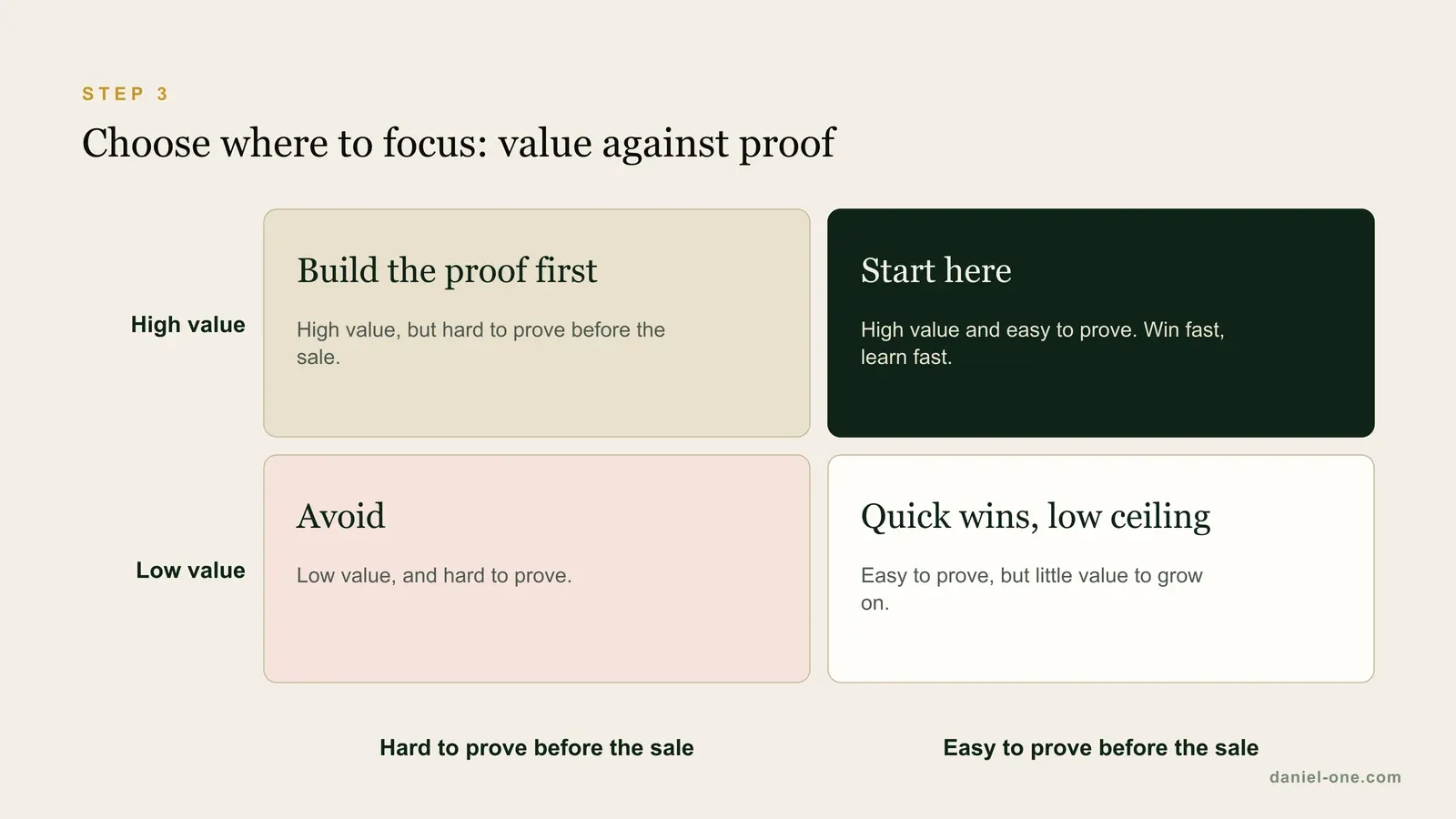
Then choose where to focus. The best first segment is often where the value is highest and easiest to prove. Where the value is high but hard to prove, build the proof first.
How to run the workshop
The method that works for me: print the canvas, gather pens and a large supply of post-it notes, and invite the people in your organisation who deal with customers most closely. Write one observation per note: not a sentence, not a paragraph, one idea. You will typically produce thirty to fifty notes before you run out of steam.
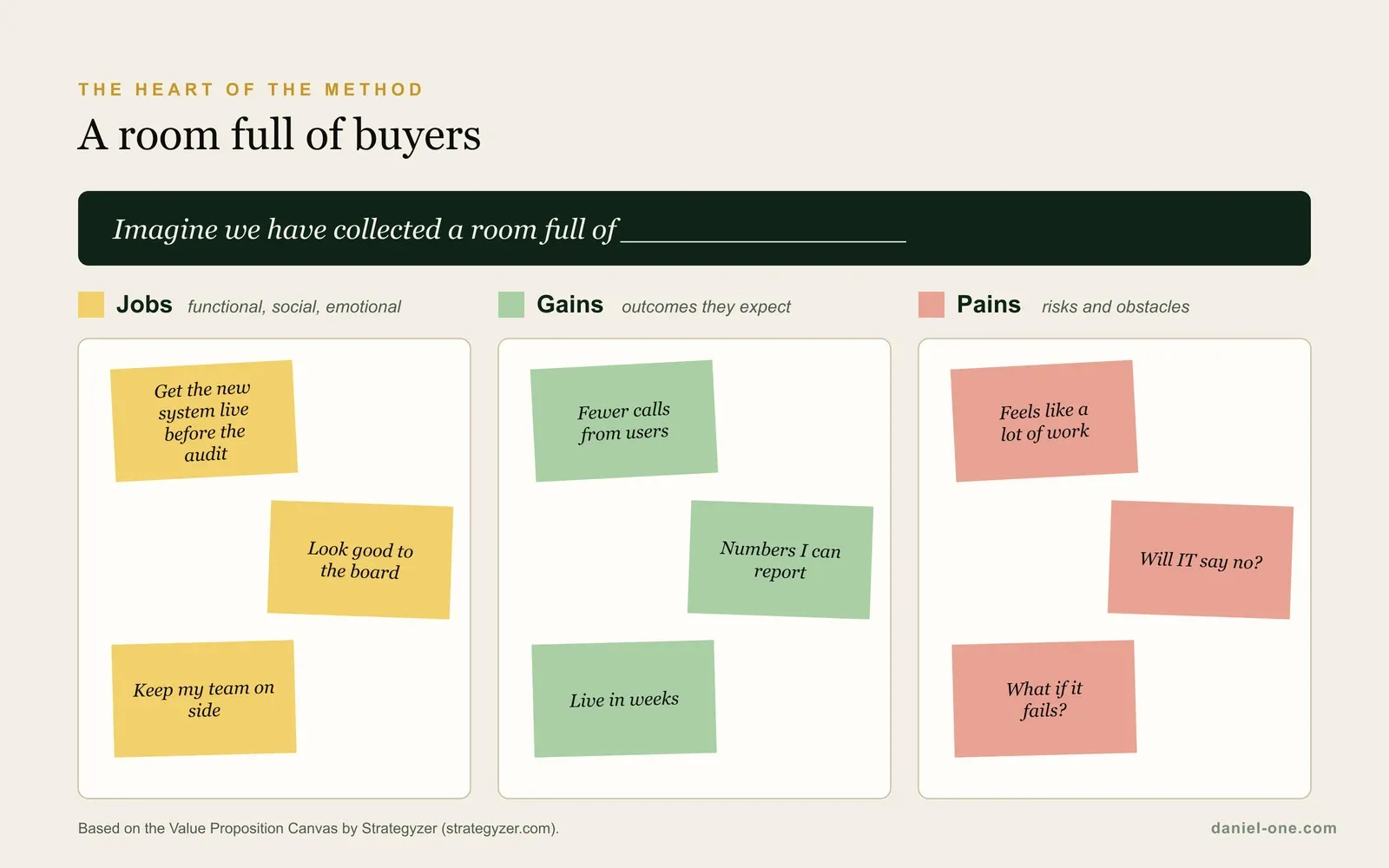
Ask for jobs of four kinds: functional, social, emotional and basic needs.
Then sort. Place each note in its section: jobs, gains, or pains. Once you have them divided, rank the notes within each section by importance. This is the step most teams skip, and it is the most valuable step. Ranking forces a conversation about what the customer actually prioritises versus what the team assumes they prioritise. That disagreement, worked through, is where the real insight lives.
When you are done, document the results: the customer jobs in ranked order with a brief comment on each, followed by pains and gains in the same format. That document is a customer profile. It is also the raw material for your value proposition, your sales process design, and your marketing messages.
Download the free tools
Free presentation templates for the frameworks I use most: value proposition, sales process, partner programme, and customer profiles.
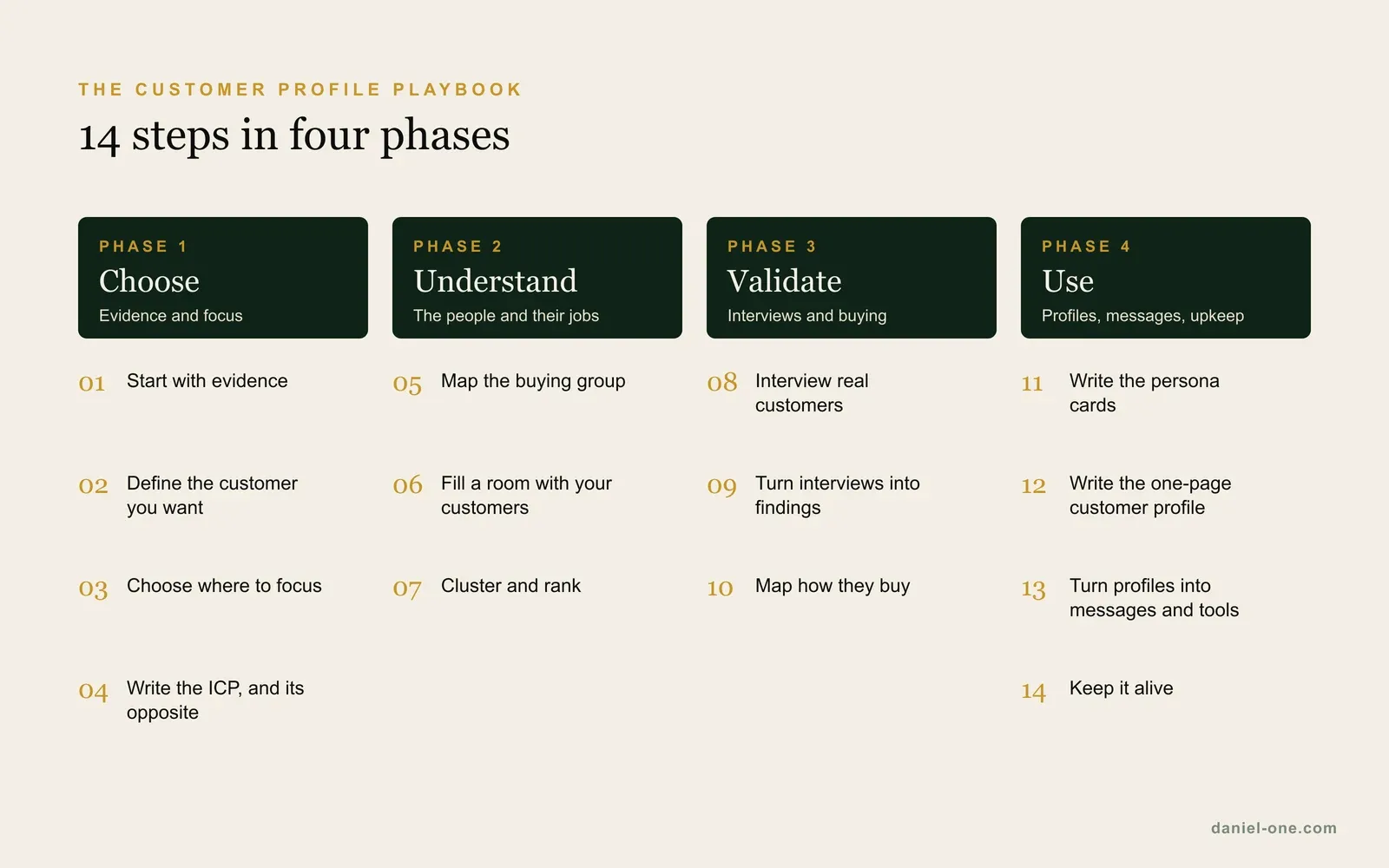
The full method in the playbook: 14 steps.
Interview real customers
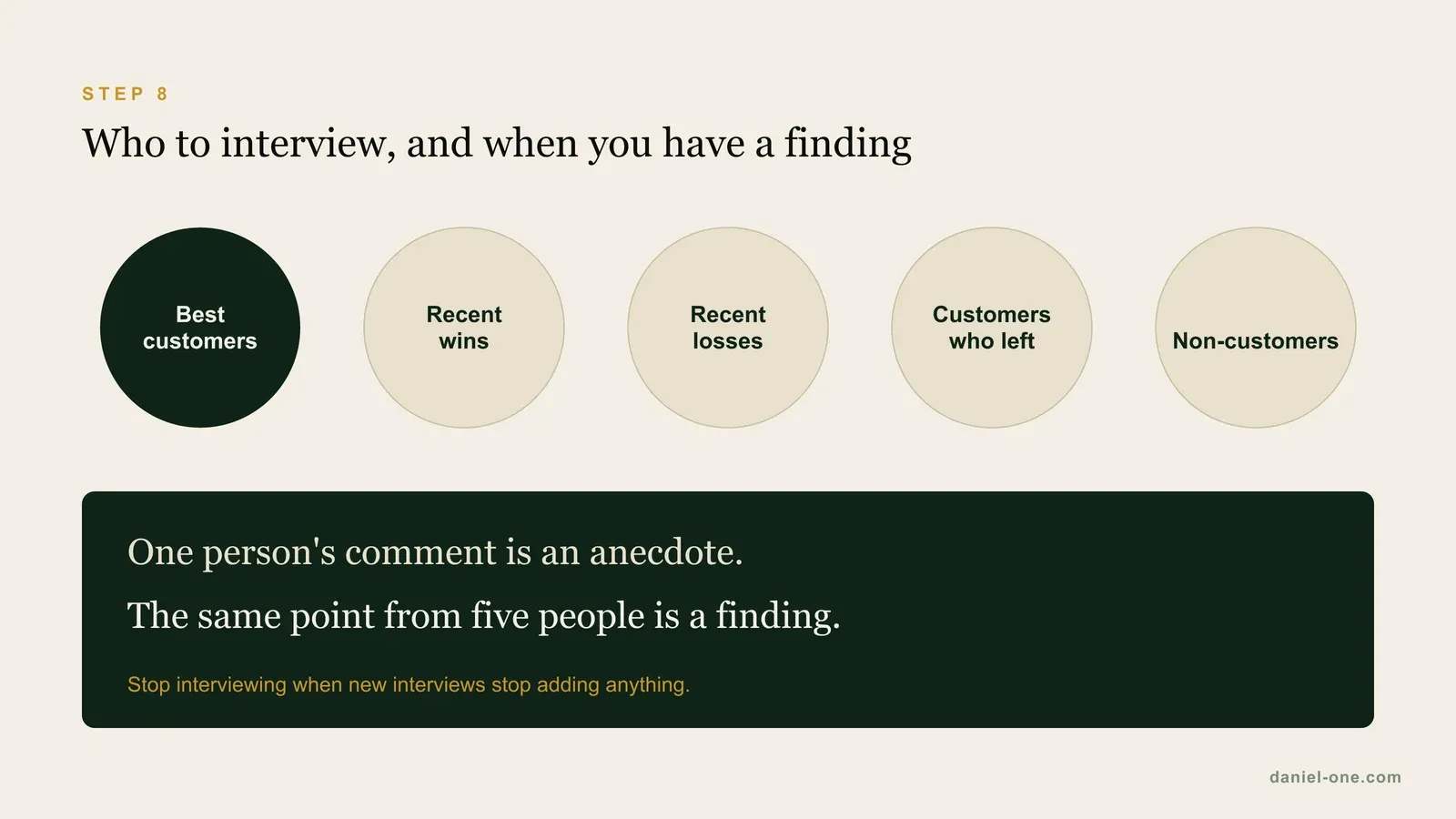
A profile built in a meeting room is a hypothesis. Interviews turn it into knowledge. Talk to your best customers, recent wins, recent losses, customers who left and people who never bought. Ask about what they did, rather than what they might do.
Six questions that work:
- When did the problem last come up?
- What did you try before, and why did it not work?
- What made you start looking?
- Who else was involved, and what did they care about?
- What nearly stopped you?
- What would you do if the solution disappeared tomorrow?
One person's comment is an anecdote. The same point from five people is a finding.
From customer profile to buyer persona
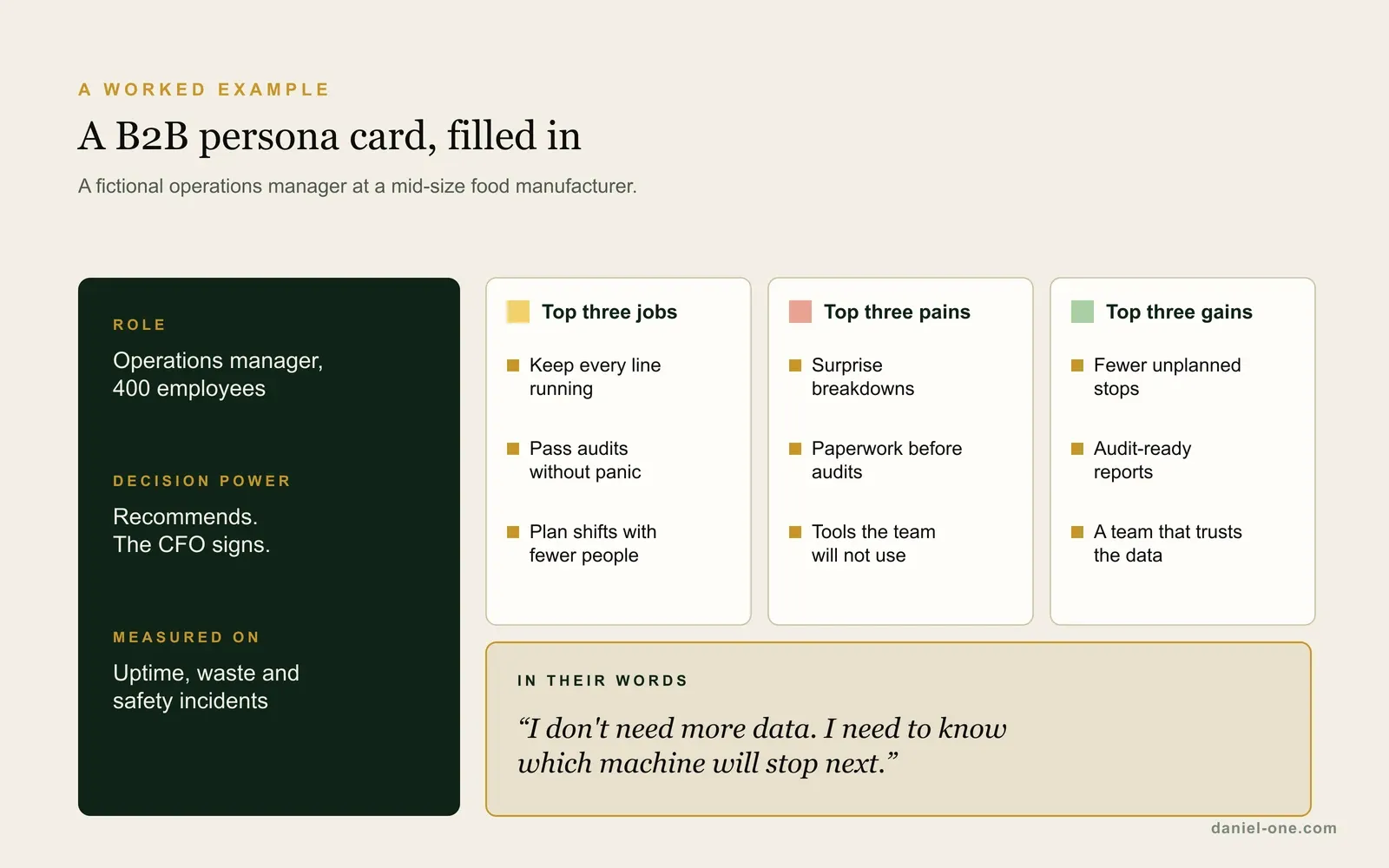
A customer profile describes what your customer is trying to do. A buyer persona goes one level further: it describes the individual human being who carries those jobs, pains, and gains into a working day.
A B2B buyer persona is a semi-fictional representation of a specific type of buyer, built from real data and real conversations. It includes their role, their seniority, their decision-making authority, their metrics, their typical objections, and, critically, what they are afraid of getting wrong. The more specific it is, the more useful it becomes.
For Mentice, the training manager at a hospital had a fundamentally different persona from the product manager at a medical device company. Same endovascular world. Different jobs. Different pains. Different measures of success. Building separate personas for each made it possible to create content, sales tools, and conversations that felt, to each buyer, like they had been written specifically for them. Because they had been.
A useful rule of thumb: most B2B companies need between two and four primary personas. More than that usually means the segmentation is being done at too fine a level, or that the ICP has not been defined tightly enough. Fewer than two usually means one persona is doing too much work and will start to feel generic.
Negative personas: The customers you should walk away from
One of the most useful things a persona exercise can produce is a clear picture of who you should not be selling to.
A negative persona, sometimes called an exclusionary persona, is a profile of the buyer type you deliberately decide not to pursue: because they are unlikely to buy, expensive to serve, unprofitable to retain, or a poor fit for what you actually deliver. Naming them takes an afternoon and saves months of wasted pipeline.
At Mentice, this meant being explicit about the doubters: the prospects who demanded ever-increasing proof before committing, who were philosophically unconvinced about simulation-based training, and who would consume disproportionate sales time in exchange for low conversion and low retention. Naming that buyer type made it easier to qualify quickly, redirect attention, and focus the commercial effort on the customers who were already motivated.
The same logic applies in every B2B context. A company selling enterprise software has a clear negative persona in the startup that needs a free solution. A professional services firm has a clear negative persona in the client who wants to pay for a day and own the output forever. Name them. It sharpens the sales process and protects the team's time.
Below video is a recorded webinar where I present how to create a customer profile + buyer persona and I show a detailed example of what it can look like.
What this work looks like in practice
When we worked with a UK-based technology company with complex software and API products, one of the first things we ran was a customer segmentation exercise to identify which industrial verticals to target and which to set aside. The company had been writing for everyone, which meant the message landed with no one clearly. Getting specific about which buyers had the most aligned needs, and building the customer profile work around those buyers, was what made it possible to reframe the value proposition and redesign the commercial approach.
With CapillaryFlow, the challenge was the reverse: four completely different customer groups (golf, equestrian, sports fields, and urban leisure) with genuinely different jobs and pains, and the need to find a unified positioning that worked across all of them. Building detailed customer profiles for each segment, then mapping what those segments shared, was what made the rebranding and messaging work. The specificity came first. The simplification followed.
I have run this work across healthcare technology, industrial products, professional services, and SaaS, and the pattern holds. When growth stalls or a message is not landing, the cause is almost always that the customer was never understood precisely enough.
I have seen the same thing in building MuchSkills, the skills intelligence platform we created at Up Strategy Lab. The platform has now mapped more than 100,000 professionals. It is a Red Dot Design Award winner and was named a Major Contender in the Everest Group PEAK Matrix in 2025 and 2026. None of that came from clever positioning invented at a desk. It came from understanding, with specificity, who the customer was and what they were trying to achieve.
I've run this work for Tele2, Sinch, CapillaryFlow, Learnit, Viking Analytics, LiveU, and MuchSkills.
Ten things customers have taught us
From customer profile workshops with software, medtech, deep-tech, telecom and education companies:
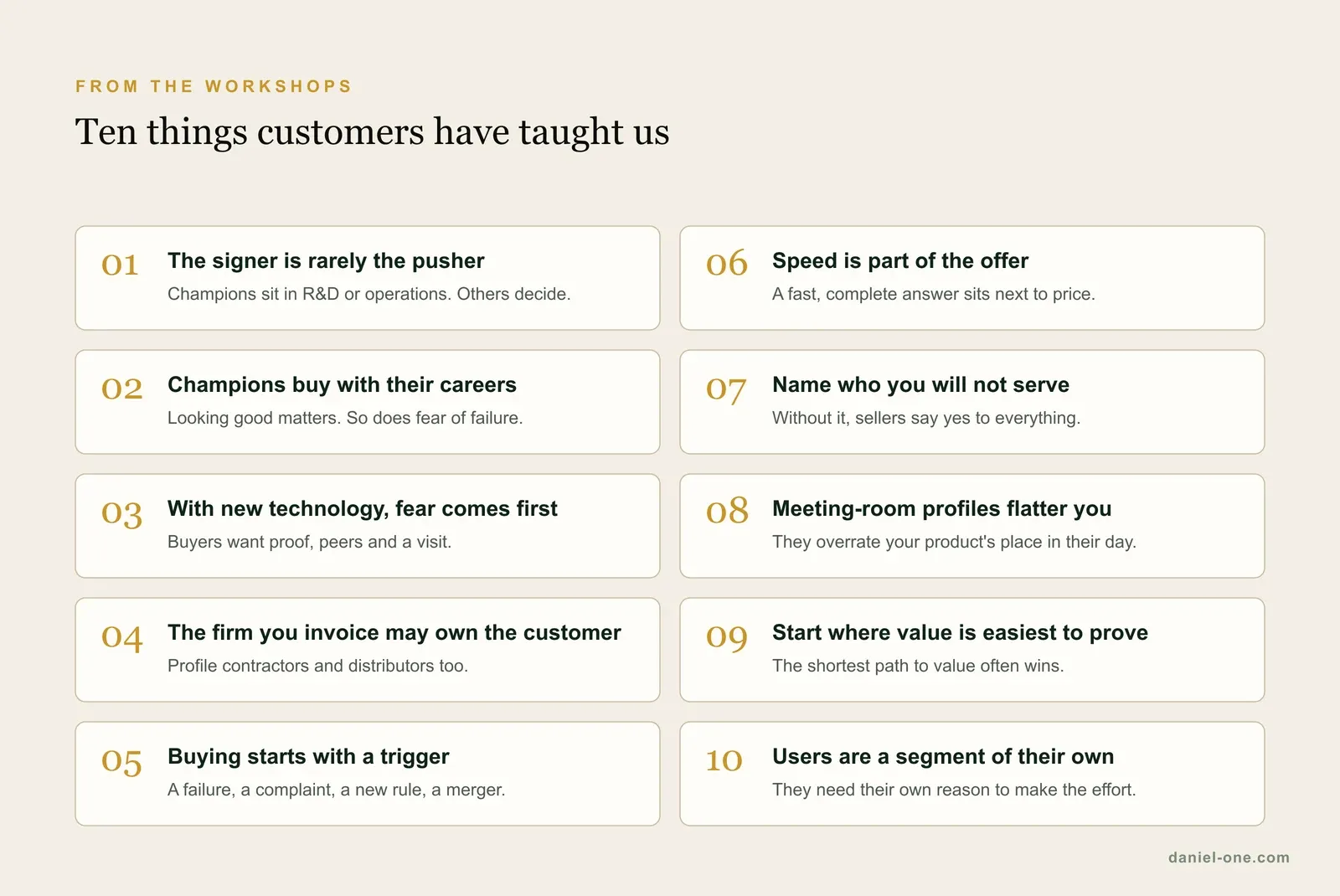
- The signer is rarely the pusher: Champions sit in R&D or operations. Purchasing or an owner decides.
- Champions buy with their careers: Looking good to leadership matters. So does the fear of a failed project.
- With new technology, fear comes first: Buyers want proof, peers and a visit. References are core tools.
- The firm you invoice may own the customer: Profile contractors, distributors and advisers as customers too.
- Buying starts with a trigger: A failure, a complaint, a new rule, a merger. Their first call is a peer.
- Speed is part of the offer: A fast, complete answer sits next to price when buyers compare.
- Name who you will not serve: Without a negative persona, sellers say yes to everything.
- Meeting-room profiles flatter you: They overrate your product and underrate what customers do themselves.
- Start where value is easiest to prove: The shortest path to delivered value often makes the best first segment.
- Users are a segment of their own: The people who use it need their own reason to make the effort.
Give your customer profile to AI
A good customer profile is also the most useful thing you can give an AI assistant. The ICP skill brief in the Customer Profile Playbook lists what it should know before it writes an email, a brief or a proposal: what you actually do, who your customers are and who they are not, their jobs, pains and gains in ranked order, how they decide, what you won and why, and the words to use and avoid.
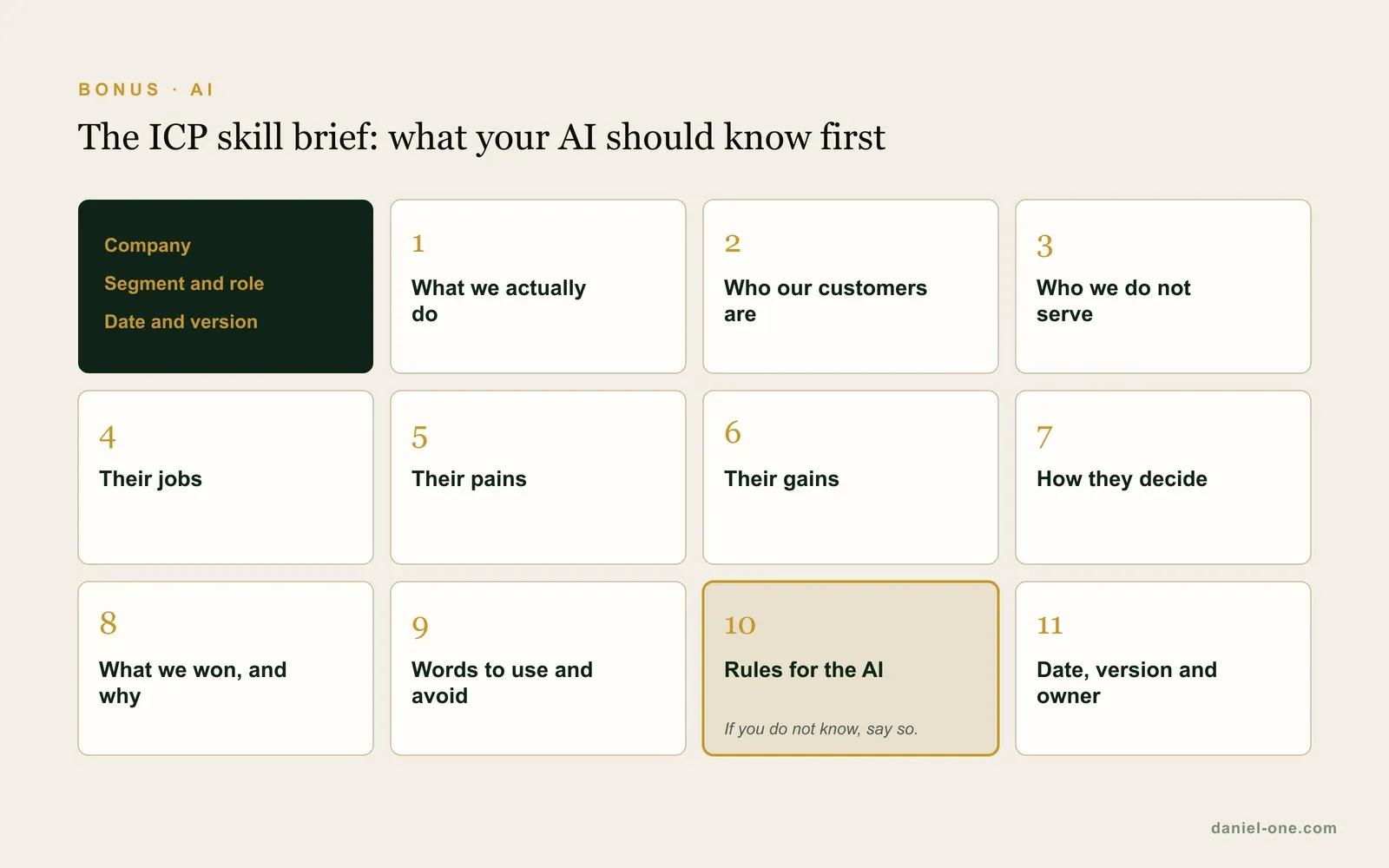
Keep it tight, dated and reviewed every quarter, feed it real evidence, and add a no-invention rule: if it does not know, it says so. I wrote more about this in AI won't make you a better salesperson. The customer work will.
Where to take this next
A customer profile is not the end of the work. It is the beginning of the commercial work.
Once you have a clear picture of your customer's jobs, pains, and gains, you can build a value proposition that maps your offering against those ranked priorities. See How to Create a Strong Value Proposition for B2B.
You can also use the customer profile as the foundation for designing a sales process that reflects how your buyer actually makes decisions. See How to Design a B2B Sales Process.
And if you want to understand the seven factors that consistently separate companies that grow in B2B sales from those that do not, the 7 Success Factors for B2B Sales covers the full picture.
Work with Up Strategy Lab
If your team has not done a proper customer profiling exercise in the last two years, it is probably overdue. Markets shift. Buyer priorities change. A profile built in 2022 is describing a customer who may not quite exist anymore. That is one of the first things we run with new clients at Up Strategy Lab. If you want to talk through what that looks like, the work with Daniel page explains the process.
Daniel Nilsson has spent more than twenty years building B2B companies and advising others on how to do the same. His guides on customer development, value propositions, and B2B sales have been read by more than 500,000 people. The Visibility Edge is the newsletter he writes when he has something tested and worth sharing. Join 7,000+ readers.
Related guides
Frequently asked questions
What is a B2B buyer persona?
A B2B buyer persona is a detailed profile of a specific type of buyer at the companies you are targeting. It is built from real data and real customer conversations, and includes the buyer's role, their key responsibilities, their typical objectives, the risks they are managing, and the objections they are likely to raise. A well-built persona is specific enough that a salesperson could use it to prepare for a meeting, or a copywriter could use it to write a page that feels like it was written for one person.
What is the difference between a customer profile and a buyer persona?
A customer profile, built using a tool like the Value Proposition Canvas, describes what your customer is trying to achieve: their jobs, their pains, and their gains. A buyer persona goes further and describes the individual person carrying those needs: their background, their seniority, their decision-making authority, their daily pressures, and what they are afraid of getting wrong. Customer profiles and buyer personas are complementary: the profile gives you the substance, the persona gives you the person.
How do you create a B2B customer profile?
The most reliable method is the Value Proposition Canvas, developed by Dr Alexander Osterwalder and Dr Yves Pigneur. Run a workshop with the colleagues who interact with customers most regularly. Use post-it notes, one observation per note, and generate thirty to fifty across the three sections: customer jobs, customer gains, and customer pains. Then rank the notes within each section by importance. That ranking conversation is where the real insight usually lives. Document the result as a structured profile, with the jobs, pains, and gains in priority order.
What is the Jobs to Be Done framework?
Jobs to Be Done is a way of thinking about customer motivation developed by Harvard Business School professor Clayton Christensen. The central idea is that customers do not buy products. They hire them to do a job. Understanding what job a customer is trying to do, and what is getting in the way of it, gives you a more accurate picture of what they need than demographic analysis alone. It is the conceptual foundation for the customer jobs section of the Value Proposition Canvas.
How many buyer personas does a B2B company need?
Most B2B companies need between two and four primary personas. More than that usually signals that the ideal customer profile has not been defined tightly enough, or that the segmentation is being done at too granular a level. Fewer than two usually means one persona is carrying too much work and will produce generic, unfocused messaging. It is also worth building at least one negative persona, a clear profile of the buyer type you are not trying to serve, which makes qualification faster and protects your team's time.
The Visibility Edge
Tested ideas on building better B2B companies, when there is something worth sending.