
In 2017, MoviePass made what looked like the best offer in entertainment: a film at the cinema every day for $9.95 a month. Several million people signed up. As customer acquisition goes, it was a triumph.
There was one problem. MoviePass paid cinemas the full ticket price. Anyone who went more than about once a month cost the company money, and those were exactly the people an offer like that attracts. One analyst called it "selling dollars for nickels". The company cut the deal to three films a month, its customers were furious, and it shut down in September 2019.
Most companies are less dramatic about it. When I sit down with founders, I ask a simple question early on: what does it cost you to win a new client? Most of them have a great idea, a good product and a lot of energy. Very few have an answer.
That is expensive not to know. A business can win clients every month, feel like it is growing and still lose money on every one of them. You find out when the bank account tells you, usually a year or two later.
Three calculations stop that from happening. They take an afternoon. Once you have them, every marketing and sales decision gets easier, because you can see what you can afford.
Customer acquisition cost: what a new client costs you
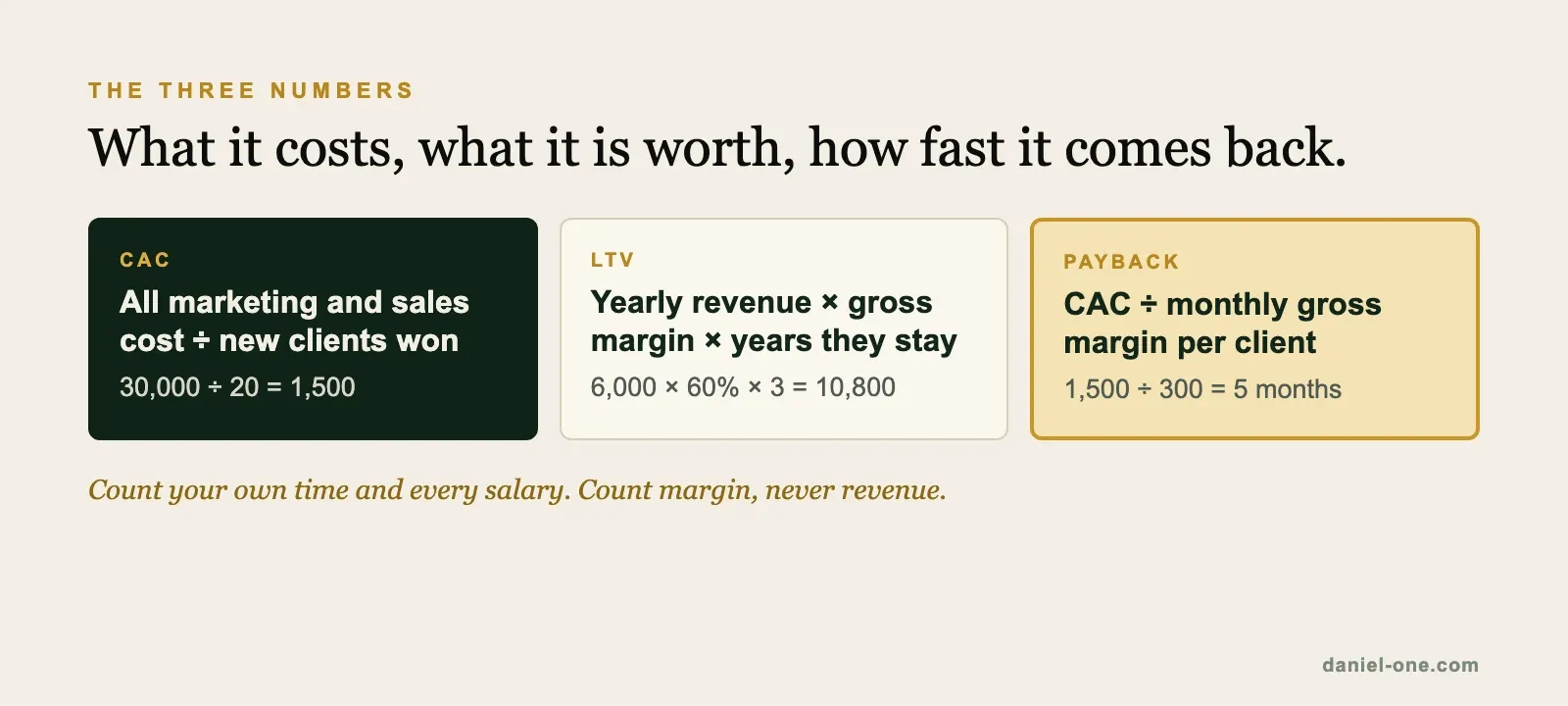
Customer acquisition cost, or CAC, is everything you spent on marketing and sales in a period, divided by the number of clients you won in that period.
CAC = total marketing and sales cost ÷ new clients won
Spend 30,000 in a quarter, win 20 clients, and each client cost you 1,500.
The formula is the easy part. Most mistakes come from what people leave out, and nearly always in the direction that flatters the number. Count all of this:
- Salaries, commissions and benefits for everyone in sales and marketing
- Your own time as a founder, at what it would cost to hire someone to do it
- Advertising, events, travel and sponsorships
- Tools: the CRM, email, website, research
- Agencies, freelancers and sales material
Founder time is the one nearly everyone skips. If you sell everything yourself, your CAC looks wonderful until the day you hire your first salesperson and it triples. Here is how that happens. You spend 30,000 a year on tools and marketing, do all the selling yourself and win 15 clients. Your CAC appears to be 2,000. Then you hire a salesperson for 60,000 all in, and they win the same 15 clients. Your costs are now 90,000, and your CAC is 6,000. Nothing got worse. You just started counting.
One more trap in B2B. If your sales cycle is six months, the clients you win this quarter came from what you spent two quarters ago. Compare spend with the wins it produced, or use a full year, or the number will jump around and tell you nothing.
Lifetime value: what a client is worth
Lifetime value, or LTV, is what a client brings in over the whole relationship. Count it in gross margin, because revenue is not what you get to keep.
LTV = yearly revenue per client × gross margin × years they stay
A client who pays 6,000 a year, at a 60% gross margin, who stays for three years, is worth 6,000 × 0.6 × 3 = 10,800.
Be honest about the years. A young company has no idea how long clients will stay, and it is tempting to assume ten years. Use what you have actually seen, and if you have seen less than three years, do not assume more than three.
Payback: how long until you get your money back
Payback is the number of months it takes for a client's gross margin to cover what it cost to win them.
Payback in months = CAC ÷ monthly gross margin per client
With a CAC of 1,500 and a client who brings in 300 a month in gross margin, you are paid back after five months.
This is the number that decides whether you survive, because you pay for growth today and earn it back later. A healthy LTV does not help if the money arrives after you have run out of it. A client who pays a year up front has paid you back on day one. The same client paying monthly is a five-month loan from you to them. In a small company, I look at payback first.
What good looks like
David Skok's SaaS Metrics 2.0 is where most of the rules of thumb come from. The best SaaS businesses, he writes, have an LTV to CAC ratio higher than 3, sometimes as high as 7 or 8, and profitability gets thin when it takes more than 12 months to recover CAC. He calls them guidelines, and says many healthy businesses do not meet them in the early days.
Use them the same way. They come from software with recurring revenue. A consulting firm or a business with one-off projects will look different. There, compare payback with the length of a typical engagement: if you only get your money back in month nine of a six-month project, you need a second project for the first one to make sense. A ratio far above 3 is not automatically good news either. It can mean you are underinvesting and leaving clients for your competitors to win.
Why you have to do it per segment
This is the part that changes decisions. An average across all your clients hides what is going on. Here is a made-up company with three kinds of client, in one quarter:
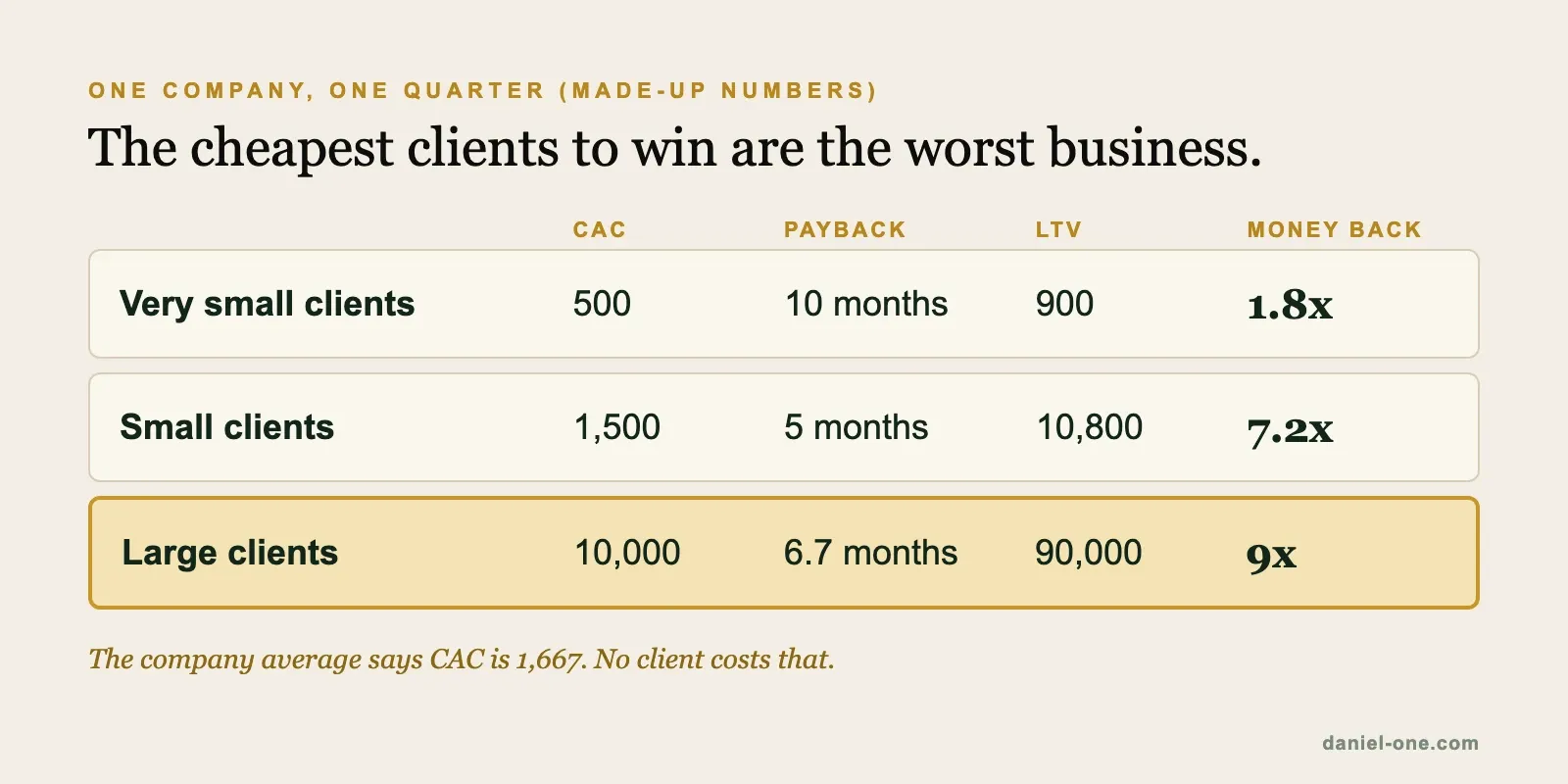
The very small clients have the lowest CAC by far, at 500. A team looking only at CAC would pour money into that segment, because it looks cheap and fast. They would be building the worst part of the business: 1.8 times the money back, after ten months, from clients who leave after a year and a half.
The large clients cost 10,000, twenty times as much as the smallest, take longer to close and make everyone nervous. They pay back in under seven months and are worth 9 times what they cost.
Best Buy found the same thing on its shop floors. In 2004 it reported that about 100 million of its 500 million yearly visits came from customers it called devils. They bought products, claimed the rebate, returned them and bought them back at the discount for returned goods. Some resold the bargains on eBay at a profit. The angels simply bought the new television at full price and took it home. In an average, the two looked the same. Once Best Buy could see them apart, it cut the promotions that drew the devils, took them off its marketing lists and put its effort into the angels.
Peter Fader, a marketing professor at Wharton, built a whole book on this idea. Customer Centricity argues that some customers are worth far more than others, and that a company should organise around the valuable ones. Your B2B devil is rarely a villain. It is usually a pleasant client who negotiated hard, asks for a lot and leaves after a year.
The average across the company says CAC is about 1,667. That number is true and useless. No client costs that.
Do the same split per campaign and per channel if you can. You will almost certainly find that some of what you are proudest of is losing money.
What to do when the numbers do not add up
Suppose you do the sums and a client who pays 250 a month, at 60% gross margin, cost you 3,000 to win. That is 150 a month in margin and a payback of 20 months. You are not stuck. There are five levers, and it helps to work out what each one is worth before you touch any of them.
- Charge more. Raise the price by 20% to 300 a month. Delivery costs the same, so your margin goes from 150 to 200, and payback falls from 20 months to 15. One decision took off five months.
- Get paid earlier. A client who pays the year up front hands you 3,000 on day one. You still have to deliver, but you have the cash to go and win the next one.
- Stop the worst spending. Say you spent 90,000 to win 30 clients, and 30,000 of that brought in only 3. Stop it, and you have spent 60,000 on 27 clients. CAC falls from 3,000 to about 2,200, and payback to about 15 months.
- Shorten the sale. Every extra meeting and proposal is cost. Qualify earlier, and say no sooner to the clients you do not want.
- Keep them longer. This does not change payback, but it does change everything you earn afterwards. How to keep B2B clients shows how much.
MoviePass had no lever left, because its price was lower than its cost on every extra ticket. You will almost certainly have several.
Do it this afternoon
I have put this into a free calculator. Fill in the white cells for up to four segments and it does the rest. Then:
- Pull last year's total marketing and sales cost, including salaries and your own time.
- Count the new clients you won, split by the segments in your customer profiles.
- Split the cost as honestly as you can. A rough split beats no split.
- Add revenue per client, gross margin and how long clients stay.
- Look at which segment pays back fastest and which one you spend most time on. If they are different, you have your next decision.
You will discover that you are missing data. Almost everyone does. Do not wait for it. Calculate with what you have, write down what you had to guess, then get the team together and decide what you will start measuring. A rough number this week is worth more than a perfect one next year.
What this changes
Knowing these numbers does not win a single client by itself. It tells you who to go after, how much you can spend doing it, and which channels to stop. That makes it step two in how to win new B2B clients, right after deciding who you want.
It also shows you what better selling is worth. Sourcing Allies used to depend on trade fairs. When we rebuilt their sales process and how they reach buyers, their cost per lead went from $2,000 to $100, their sales conversion rate went from 0.7% to 20%, and the sales lead time went from two years to under six months. Do the rough sum. $2,000 a lead at 0.7% conversion ($2,000 ÷ 0.007) is about $285,000 of lead cost for every client won. $100 a lead at 20% ($100 ÷ 0.20) is $500. Same company, same market, and a completely different business.
Would you like a second pair of eyes on your segment table? Talk to us at Up Strategy Lab.
Frequently asked questions
What is a good customer acquisition cost?
There is no universal number. It depends on what a client is worth to you. A CAC of 10,000 is excellent if a client brings in 90,000 in gross margin, and 500 is a disaster if they bring in 400. Compare CAC with lifetime value and payback for each customer segment.
What is a good LTV to CAC ratio?
A common guideline from SaaS is above 3, with the best businesses at 7 or 8. It is a rule of thumb, it comes from recurring revenue software, and many healthy young companies do not meet it. A ratio far above 3 can also mean you are spending too little on growth.
Should lifetime value use revenue or gross margin?
Gross margin. Revenue includes the cost of delivering your product or service, and you cannot spend that on winning clients. Using revenue makes your ratio look several times better than it is.
What should be included in customer acquisition cost?
Everything spent on marketing and sales: salaries, commissions, the founder's time, advertising, events, travel, tools, agencies and sales material. Leaving out salaries and founder time is the most common mistake, and it can make CAC look a fraction of what it really is.
How do you calculate CAC with a long sales cycle?
Compare what you spent with the clients that spending actually produced. With a six-month sales cycle, the clients won this quarter came from the spending two quarters ago. Using a full year also smooths this out.
How do you calculate CAC payback?
Divide your customer acquisition cost by the monthly gross margin a client brings in. If a client cost 1,500 to win and brings in 300 a month in gross margin, your payback is five months.
The Visibility Edge
Tested ideas on building better B2B companies, when there is something worth sending.