I have lost count of the entrepreneurs who have told me their idea is validated. They did the work. They interviewed a hundred people, and seventy said they would buy.
That number may well be true. It is also close to worthless. When you ask those same seventy people for a credit card, you will be lucky if five go through with it.
People are polite. Saying "I would definitely buy that" costs nothing, and it makes an awkward conversation pleasant. Wanting to buy and buying are two different things, and only one of them pays your salaries.
So the question is how to find out for real, before you spend a year and all your money on the answer. It is step four in how to win new B2B clients, and it may be the one that saves you the most.
Three companies that tested it properly
Dropbox had a product that was hard to explain and hard to build. Instead of finishing it, Drew Houston made a short video showing how it would work. It reached the right community, and the waiting list went from about 5,000 to 75,000 people. They had not used the product. They had seen exactly what it did and left their email to get it.
Buffer started as two web pages. The first explained the idea. If you clicked through, the second said it was not ready and asked for your email. When emails came in, Joel Gascoigne added a pricing page in between, with three plans. Now he could see who would click on a paid plan. Only then did he build it, and the first paying customer arrived within four days of launch.
Warby Parker needed to know if people would buy glasses without trying them on. So they removed the risk: pick five frames, they ship them to you free, and you have five days to try them at home with no obligation to buy. The test became the business model.
Each one found a way to get real behaviour from real strangers, at very little cost.
Two that did not even build anything
Around 1995, Jeff Hawkins wanted to know if a handheld computer could really work, so he cut a block of wood to size and carried it around in his pocket. He used a chopstick as a stylus. He pretended to take notes on it in meetings, and counted the steps each task would take. People thought he was crazy. That block became the PalmPilot, and it now sits in the Computer History Museum.
IBM had an even better one. Long before speech recognition worked, it wanted to know if people would actually want it. So it sat people in a room with a microphone and a screen and no keyboard, and told them their words would appear on the screen. They did, quickly and accurately, because a fast typist was sitting in the next room. It turned out that talking all day gave people sore throats, that it was unworkable in noisy offices, and that many worried about being overheard. IBM learned all that without writing the software.
Alberto Savoia, who ran engineering at Google in its early days, calls this a pretotype, and his book The Right It is full of them. His argument is that most new ideas fail even when they are built perfectly, so test whether it is the right thing before you build it right.
What this means in B2B
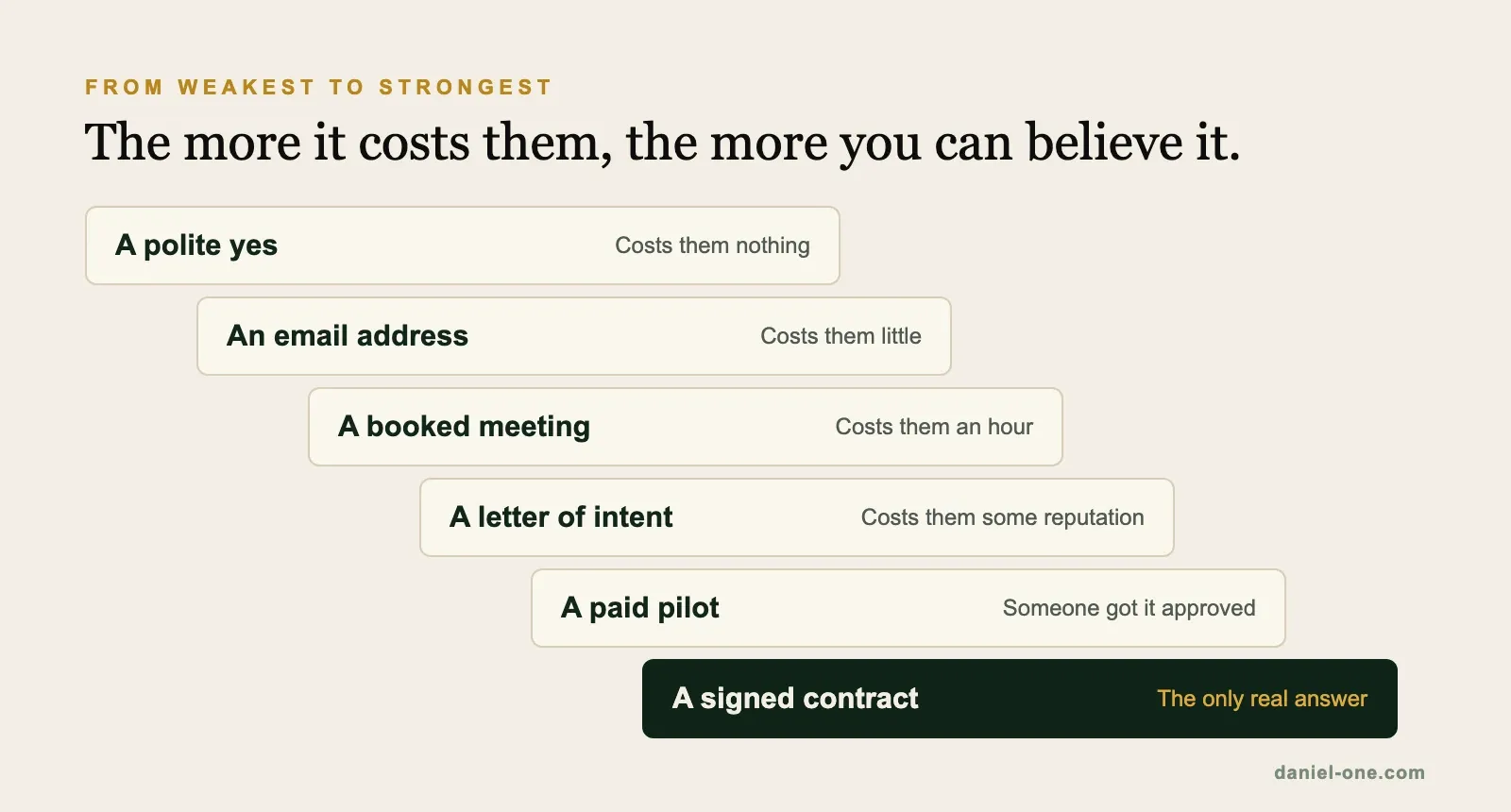
None of those companies had a buying committee. Your buyers do not click on a landing page and pull out a card, and you do not have thousands of them. The principle holds, but the experiments look different. The closer you get someone to spending real money or real reputation, the more you can believe the answer.
Here they are, from weakest to strongest evidence:
- Field research. Go where your customers are, and watch what they do.
- In-depth interviews. Cheap, and essential to start with. Ask about what they have actually done, and do not ask what they would do.
- A small ad campaign. Target very specific search terms or job titles, and work out what each booked meeting cost you. Clicks tell you very little.
- A free webinar or workshop. See who shows up, and who gets in touch afterwards.
- A one-to-one offer. Email ten strangers in your ideal segment with a specific offer. Do they answer?
- A pitch to a real buyer. Make a proper pitch to people who fit your profile. Their questions and objections are worth more than the yes or no.
- A letter of intent. Ask them to sign something. Watch how many of the enthusiastic ones find a reason to wait.
- A paid pilot. Even a small fee changes the conversation. Someone had to get it approved, which means someone inside the company believes in it.
- A pre-order or a signed contract. There is no stronger evidence than this.
You can run them in sequence. Start with research and interviews, and move towards purchase when you know enough to make a serious offer. If you have more ideas than time, rank them on three things: what you stand to gain if it works, how well it fits your goals and what you can actually do, and the risk of it running over budget or over time.
A paid pilot is a good place to aim for, and it is less strange to ask for than you may think. Forrester reports that more than 60% of business buyers use some form of trial before they buy. They expect to try.
What a test looks like, worked through
Here is a made-up example. Northline wants to sell a compliance tool to engineering firms of 50 to 500 people, who lose bids because they cannot prove their certifications in time. Before contacting anyone, the team writes down the bar: out of 30 strangers, at least six meetings and two paid pilots at 4,000, or we think again.
Weeks one and two: interviews. They talk to ten people who run bids, and ask about the last bid they lost. Eight have a story about a certificate. Promising, and still only talk.
Weeks three to eight: a real offer. They write to 30 heads of bids they have never met, each with a specific reason, and offer a three-month pilot at 4,000. Nine reply. Five take a meeting. One signs.
The afternoon after. They missed the bar on both counts. It would be easy to call five meetings a success, which is why they wrote the bar down first. Going through the calls, they notice that the bid managers loved it and could not spend 4,000 without the managing director, who did not feel the pain. So the next test changes one thing: a shorter offer, written for the managing director, about bids lost in money.
That is a good result. It cost two months and very little money, and they now know something no interview would have told them.
Six rules for a test you can believe
Go after your ideal customer directly. Test on the people you would actually sell to, and leave everyone else out of the results. A hundred responses from the wrong people tell you nothing.
Test with strangers. When we have a new idea, it is tempting to ask friends and former colleagues. They care about you. Your most important tests should be with people who have no emotional connection to you and no reason to be nice.
Ask for something real. A casual chat gives different answers from a request for a signature. Design every test to move people as close to a real commitment as possible.
Make it good enough. A clumsy website will fail however good the idea is, and you will draw the wrong conclusion. It does not have to be finished. It has to be credible.
Decide in advance what counts as success. Write it down before you start: "If at least three of these ten agree to a paid pilot, we go ahead." Without that, you will explain away any result.
Treat data as advice. What you have is what happened in that test at that moment. Run it again next quarter, and you may get something else. Look for patterns over several tests, and stay sceptical of your favourite result.
How long it takes
Plan the test in a few hours. Running it takes between one and three months in most B2B markets, because buyers are slow and people go on holiday. Then spend an afternoon on the result, and ask:
- Is this really the right customer, or did we learn about another segment we had not considered?
- What should we change in the offer?
- What would it cost to win a client this way? Do the maths, even if it is rough.
- Do we go ahead, change something and test again, or stop?
Stopping is a good result. You have just saved a year.
When you already have a business
This is not only for startups. It matters just as much when you go after a new segment, launch a new service or enter a new country. Your current customers will be polite too, and a new segment may look nothing like the old one. Test it before you move your team, and make sure you are not neglecting the clients who pay you today.
Want help designing a test with a bar you cannot talk your way around? Talk to us at Up Strategy Lab.
Frequently asked questions
How do you validate demand for a B2B product?
Move potential buyers as close to a real purchase as you can. Start with interviews about what they have actually done, then try a specific offer to strangers in your ideal segment, a pitch to real buyers, a letter of intent or a paid pilot. The more real money or reputation they put in, the more you can trust the answer.
Why do people say they would buy and then not buy?
Saying yes costs nothing and makes the conversation pleasant. People are polite, and they are poor at predicting what they will do. That is why it is better to ask about what they have actually done, and to test with a real commitment.
What is a good way to test an ideal customer profile?
Run the same offer to two or three specific segments and compare what happens: who replies, who books a meeting, who agrees to a paid pilot. Define what success looks like before you start, and test on strangers.
What is a pretotype?
Alberto Savoia's word for the cheapest possible way of finding out if people want something before you build it. Jeff Hawkins carrying a block of wood as a pretend PalmPilot is one. IBM hiding a typist behind a fake speech recognition system is another.
How long should a market test take?
Plan it in a few hours. In B2B, running it usually takes one to three months, because buyers are slow. Then take an afternoon to go through the results and decide whether to go ahead, change something or stop.
Should I test with friends and existing customers?
Use them for early feedback, but not as your main evidence. People who like you want you to succeed and will be kind. Your most important tests should be with people who have no connection to you.
The Visibility Edge
Tested ideas on building better B2B companies, when there is something worth sending.