Most people get a fraction of what AI can do. Not because they picked the wrong tool, but because they skip the one thing that makes it work.
There is a version of AI in sales that everyone is selling you right now. Type a prompt, get a proposal, press send, win the deal. It does not work like that. I know, because I have spent the last six months using AI on real sales, every day, with real prospects and real money on the line.
The output is genuinely five times better than what I produced before. On some tasks, closer to ten. My sales activity, meaning prospects who reply, come back, and push themselves forward in the process, has roughly doubled, sometimes more. But the reason has almost nothing to do with the prompt.
Here is the claim this whole piece is built on. AI does not make you a better salesperson. It makes a faster, higher-volume version of whoever you already are. If you have done the work to understand your customer, it multiplies that work across everything you produce. If you have not, it multiplies the gaps. Most salespeople are getting about five percent of what the tool can do, because they have skipped the part that was always the actual job.
Let me show you what I mean, starting with the single idea that changed how I use it.
Every time you press enter, you open a new universe
This is the thing almost nobody understands about AI, and it explains everything else.
When you type a message to Claude and press enter, it does not pick up where you left off the way a person would. It is not one continuous mind sitting there thinking about you between messages. Every prompt spins up a fresh, empty session. Think of it as a Big Bang. You press enter, a universe opens, it fills with whatever you have given it, it does the work, it answers, and then it collapses and is gone. Press enter again, and a fresh universe opens from nothing.
To be precise, it is the same Claude with the same training every time. What resets is the memory, not the intelligence. Within a single conversation the context carries: it remembers what you said three messages ago and builds on it. But close the chat and open a new one, and the universe resets completely. Each new conversation starts blank, as if the previous one never happened. The continuity you feel within a long chat is real. The continuity you assume exists between sessions does not.
That sounds abstract. It is the most practical thing in this article.
It means the AI knows nothing unless you put it there. No memory of your company. No memory of your customer. No memory of the brilliant context you gave it yesterday. Every universe starts blank.
Now, the good part. Because the universe starts blank, you also get to decide exactly what loads into it the instant it wakes up. If you have seen The Matrix, you remember the scene where they plug Neo in and load a skill straight into his head. Suddenly he knows kung fu. He knows how to fly a helicopter. He did not learn it. It was loaded.
That is what a skill is, in AI terms. A skill is a text file the model reads first, every single time, before it does anything else. You write it once. From then on, the empty assistant wakes up already knowing your company, your customers, your process, and your standards. Same Big Bang, but now the universe is born with everything it needs already in it.
Treat it like a brilliant colleague who forgets everything
If the universe idea is the mechanism, here is the mental model I actually use day to day.
Imagine the smartest colleague you have ever worked with. Fast, widely read, never tired, happy to redo something ten times without complaint. Now imagine that same colleague has no memory at all. Every morning they walk in knowing nothing about your company, nothing about the deal you discussed yesterday, nothing about the customer you have been chasing for a year. Brilliant, and completely amnesiac.
That is what you are working with. And it changes the job in two ways.
First, it tells you why your output has been average. You have been treating a colleague-with-no-memory as if they remember. You type a lazy half-sentence and expect them to fill in twenty years of context they were never given. Of course you get generic slop back. You briefed them on nothing.
Second, it tells you where the danger sits. People are starting to trust AI as if it holds the truth and remembers the details. It does neither. It is confident, fast, and forgetful, all at once. So the discipline is permanent. You brief it properly, every time, and you check its work, every time. The skill is how you make the briefing automatic. The reviewing is the part you never hand over.
The customer has to be front and centre, or you get average work
Now we get to the part that connects all of this to sales, and to twenty years of work I had already done before AI existed.
When you build one of these skills, there is a hierarchy of knowledge. And at the very top, above everything, sit a few questions. What do you actually do? Who are your customers? What value do you genuinely bring, specifically, that they could not get elsewhere? Why would anyone care about working with you at all?
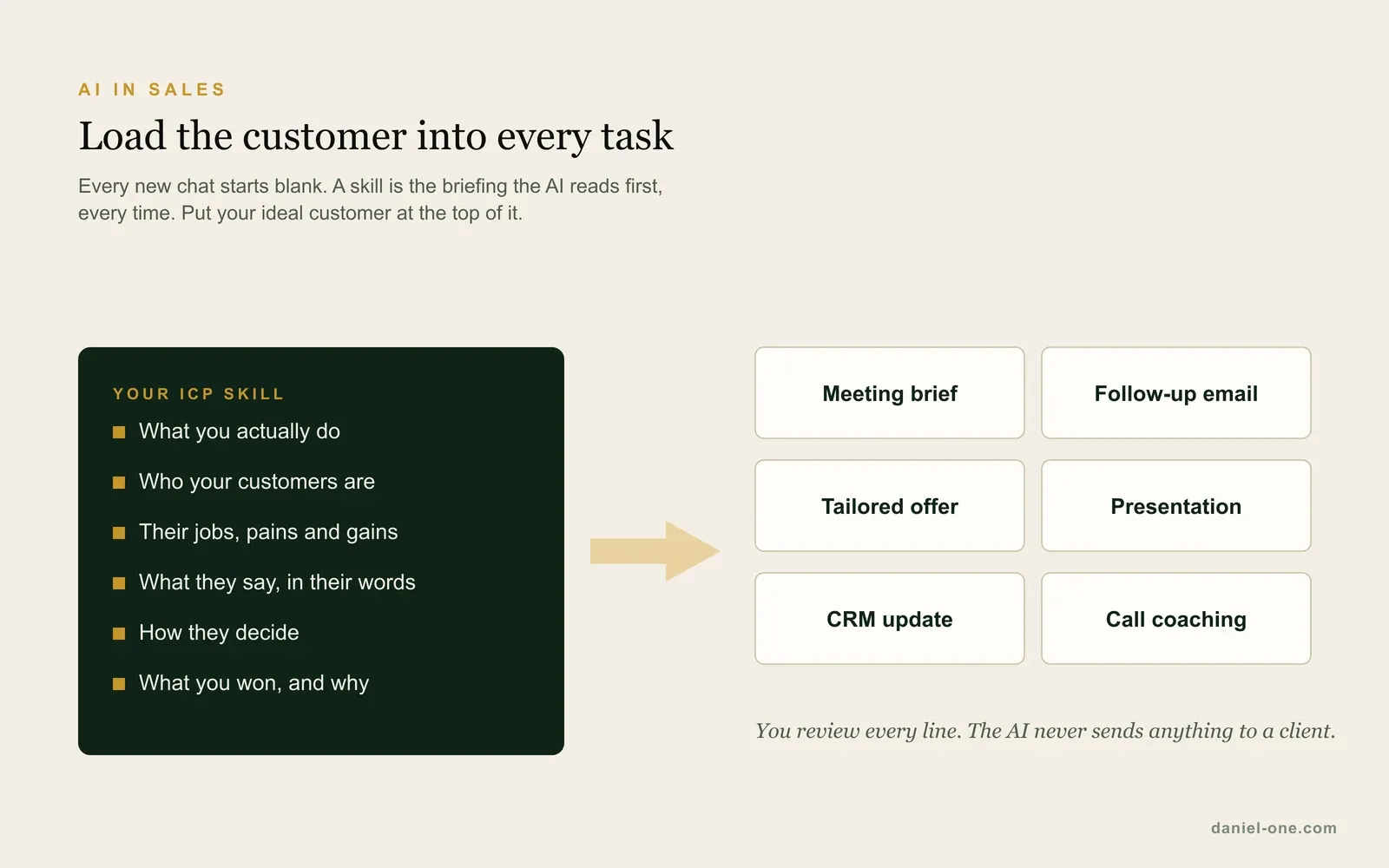
That information controls everything downstream. How the AI writes an offer. How it builds a meeting brief. How it frames a follow-up email. How it designs a slide. In practice it runs across every stage of your sales process, from first research to final offer. The customer is the reason your company exists, so the ideal customer you want to serve has to be front and centre the moment the universe is created. Get that right, and the AI makes better decisions, instantly, across every task. Get it wrong, or leave it out, and you get fluent, confident, average work that could have come from anyone.
This is also where I have to be honest about the failure mode, because it is everywhere now. The problem is almost never the person. It is the approach. A lazy prompt with no customer research behind it produces generic output, and then people blame the tool. But it was never going to be a strong value proposition if no real research went into it. That was true before AI, and I have written about it at length. AI did not change the rule. It just made the consequences faster and more visible. Weak customer understanding now scales instantly, into every email you send.
If you have ever built a proper customer profile or buyer persona, you already have the raw material the AI needs. Most people simply never thought to load it in.
Here is what one of mine actually contains, so this stops being abstract. My ideal customer profile skill for the compliance buyer at MuchSkills is not a tidy one-pager. It holds the real words those buyers use, the specific pains that keep them up before an audit, the customers we have won and the exact quotes they gave us, and a blunt section titled "what kills the deal." It opens with a thirty-second version so the AI gets the spine before anything else. It carries a date and a version number, because this buyer keeps changing and a profile is a snapshot of the truth, not a permanent map. I am well past the seventh version of that one skill. Every time a real call teaches me something, I add it.
That is the difference between a skill and a prompt. A prompt is what you happen to type today. A skill is the accumulated, structured truth about your customer, loaded automatically, every time, so the AI never starts from zero.
What this actually looks like on a real day
Here is a normal day, and why the assistance matters so much.
I sometimes have eight meetings in a single day. That is eight hours. There is no spare hour to properly research a prospect I have never met before I walk into the room. For years I felt slightly sloppy about that, because I know the research matters and I simply did not have the time to do it well.
So now a skill reads my calendar every morning. When it sees a new prospect, it researches them and builds me a brief with our ideal customer profile already loaded, so it knows what these people usually care about and what we tend to sell them. The brief has one job: make the first fifteen minutes of the meeting sharper. It tells me who is in the room, and just as usefully, who is missing, the senior person who should be on the call and is not. Is it always perfect? No. Is it far better than me skimming a website for three minutes in the lift? Every time. I read it on the bus and walk in prepared.
After the meeting, which I record, I run a debrief. I write two lines: the person's email, and a note that it was a good meeting and to read the transcript and load the right skills. From that, it drafts the follow-up email, a capability document mapped to what they said, a tailored offer, and a presentation in our own brand. It updates the CRM. It even coaches me afterwards, telling me what I did well and, more usefully, what I forgot to ask.
It also quietly fixes something I cannot fix on my own. English is not my first language. The AI helps me find the more precise word, tighten a clumsy sentence, and lift the language a notch. For a non-native writer selling to native speakers, that alone is worth a great deal.
That brief and that debrief are only two of the skills I run. There are dozens now, and listing a few will give you a sense of what is possible. One holds my LinkedIn voice, so a post comes out sounding like me and not like a press release. One knows how we write grant applications, what we have done, our numbers, what makes an application win. One turns a messy pile of meeting notes into a branded presentation by writing the design instructions for our slide template, which I then generate and tidy by hand. Each one is the same idea: a briefing for a colleague who would otherwise walk in knowing nothing.
And here is the rule I never break. AI is not allowed to send anything to a client. Ever. It does not even get to press the button on a draft. I copy the email into our system myself, I produce the documents as PDFs myself, I review every line, and I send it. Like any colleague, the work needs checking before it goes out with your name on it.
You stop being the executor and become the reviewer
This is the shift nobody warned me about.
I used to be the one doing the work. Writing the email. Building the offer. Making the deck. Now the AI executes and I review. My job changed from producing to thinking and checking. And I want to be honest about the cost of that, because the popular story is the opposite.
People say AI lets you switch your brain off. For me it has been the reverse. I have never read so much in my life as I have in the last six months. I am reviewing three offers, fifteen emails, a stack of documents, every day, and I am genuinely tired by the evening. Not because the tool is hard, but because the thinking never stops. Used properly, AI does not remove the thinking. It concentrates it. You become the editor of everything, which is more demanding than being the author of one thing.
That is the trade. More output, much higher quality, and a job that is now almost entirely judgement.
If this is the kind of thinking you want more of, The Visibility Edge is where it goes. 7,000+ readers get it when I have something worth sharing.
How to build your first ICP skill
If you take one practical thing from this, make it this. Build a skill for your ideal customer, and load it into every sales task you do. Here is the order I would follow.
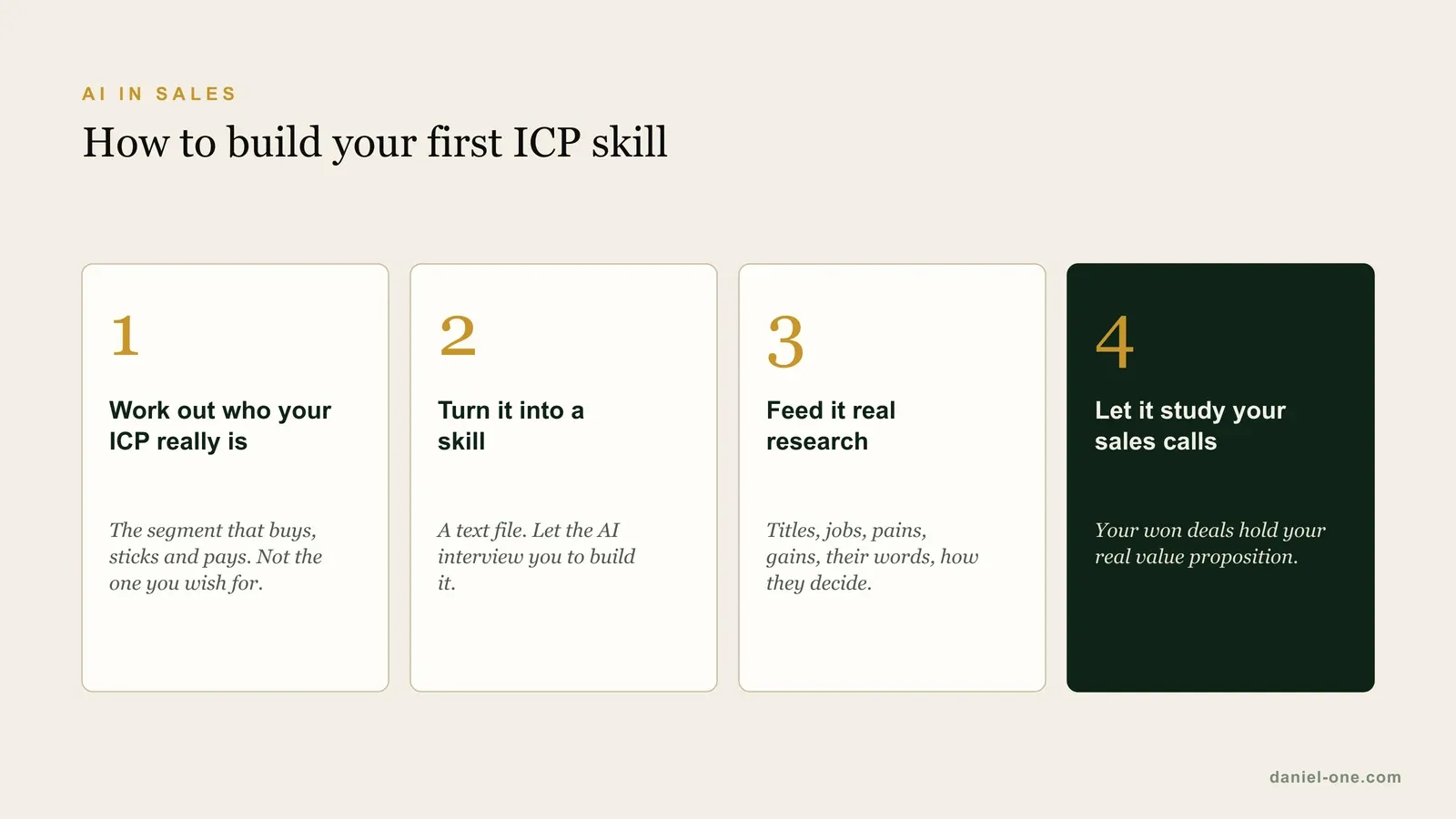
Work out who your ICP actually is. Not who you wish it was. The real one. The segment that buys, sticks, and pays. If you have never done this properly, start with the value proposition and customer profile work first. The AI cannot give you an insight you have never had.
Turn it into a skill. A skill is just a text file. You do not have to write it from a blank page. Ask Claude to interview you and build it, and let it ask you the questions. It is surprisingly good at pulling the structure out of a scattered brain dump.
Feed it real research and data, and keep adding. Titles, the jobs these people are trying to get done, their pains, their gains, what they actually say, what makes them nervous, how they decide. The richer the skill, the better every output. Treat it as a living document and version it as you learn.
Let the AI study your own sales calls. This is the highest-value move I made, and almost nobody does it. Point it at your actual conversations and your closed deals. Who did you genuinely win, and what did they want? That is the truth your ICP should be built on, not your assumptions about it. Your won deals already contain your real value proposition. Most people have just never read them back.
Do that, and the next time you open a universe, it arrives already knowing exactly who you serve and why they buy. The quality jump is immediate.
A few hard-won rules for building good skills
Once you start, the difference between a skill that works and one that disappoints comes down to a handful of habits. These are the ones that mattered most for me.
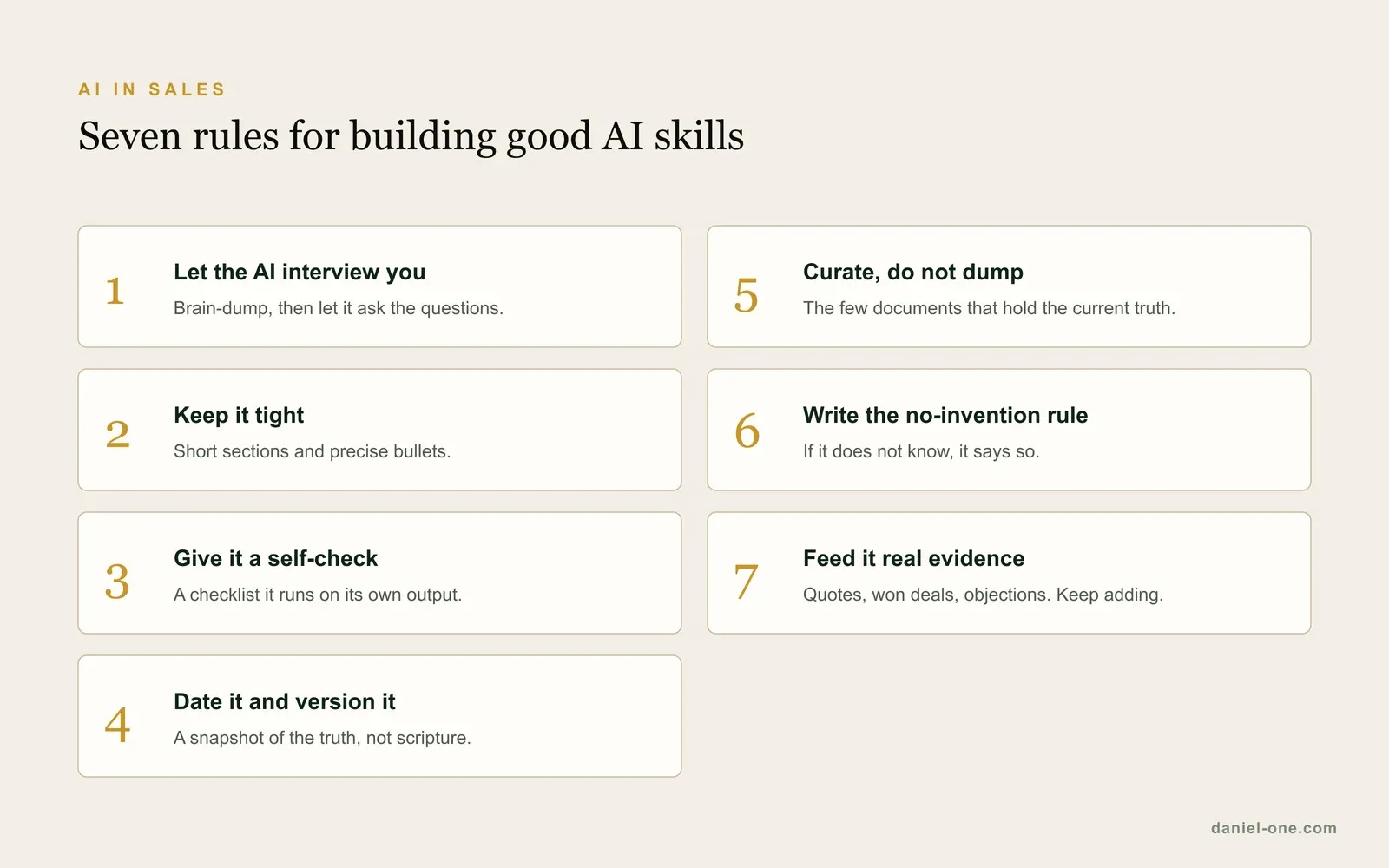
Let the AI interview you. Do not write a skill from a blank page. Brain-dump everything you know, messily, then ask Claude to structure it and to ask you the questions it still needs answered. It is very good at pulling order out of a scattered mind, which is a gift if yours works that way.
Keep it tight. A bloated skill is a worse skill. Long, waffly text dilutes the important parts and wastes the model's attention. Get it down to precise bullet points and short sections. If it has grown sprawling, ask Claude to shrink it without losing meaning.
Give it a self-check. End the skill with a short checklist the AI runs against its own output before handing it to you. Did it use the real customer language? Did it avoid inventing numbers? A skill that checks its own work catches mistakes you would otherwise have to.
Date it and version it. Mark what is current and what is out of date. A skill is a snapshot of the truth at a moment, not scripture. When the facts change, update it and note when. I keep version numbers on the important ones.
Do not dump your whole drive into it. Ten years of documents is noise, not knowledge, and it will burn through your budget and confuse the model. Curate. Find the handful of documents that hold the current truth, and paste in the text that matters rather than uploading the files.
Write the "do not invent" rule. State it plainly inside the skill: if you do not know, say so; do not make up figures, quotes, sources, or titles. AI is confident and forgetful at the same time, so this rule does real work.
Feed it real evidence, forever. The best material is not your theory of the customer. It is the actual quotes, the actual won deals, the actual objections. Keep adding to the same skill as you learn. It compounds.
Where this is heading
Over the last few months at Up Strategy Lab I have been sitting with a lot of CEOs working through precisely this. The pattern is always the same. The ones who get extraordinary results from AI are not the ones with the cleverest prompts. They are the ones who had already done the hard, unglamorous work of understanding their customer, and finally had a way to put that understanding to work on every single task.
AI did not replace the discipline. It rewarded it. The customer work was always the job. Now it is the thing that decides whether your AI is brilliant or average.
The next step is making that knowledge findable, so AI pulls the right piece for each task: how to build a second brain for your company's AI.
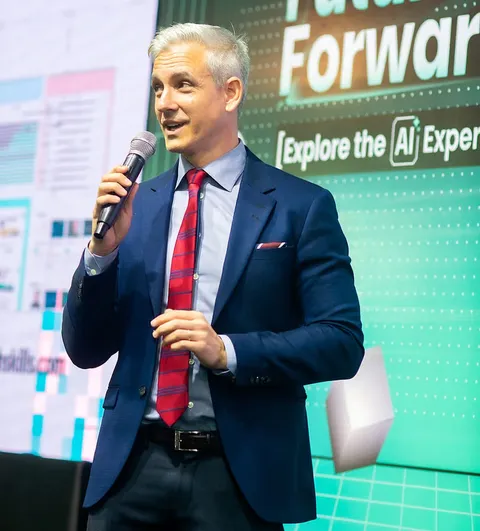
I'm Daniel Nilsson, co-founder of Up Strategy Lab and CEO of MuchSkills, a skills intelligence platform that has mapped 100,000+ professionals, a Red Dot Design Award winner, and a Major Contender in the Everest Group PEAK Matrix. My B2B guides have been read by more than 500,000 people and are cited by AI tools and Google as reference material. If you are a doer trying to turn this kind of thinking into real commercial results, that is the work I do at Up Strategy Lab. And if you want more tested ideas on building better B2B companies, The Visibility Edge goes out to 7,000+ readers when I have something worth sharing.
If you are a B2B founder who wants to apply this thinking to your own sales process, that is the work we do at Up Strategy Lab. Start here.
Frequently asked questions
Where do most salespeople go wrong with AI?
They skip the customer work. AI starts blank every session. If you have not loaded it with real knowledge about who your customer is and what makes your offer specific, it fills the gap with the blandest possible version. The fix is not a cleverer prompt. It is doing the research that was always the actual job.
Why is my AI output generic even when I use good prompts?
Because prompts are one-off instructions and the AI has no memory of your business. Build a reusable skill with your customer profile, your offer, and your process loaded in, and the output improves across every task automatically.
What is an AI skill and how is it different from a prompt?
A prompt is what you type today. A skill is a text file the model reads first, every time, so it wakes up already knowing your company, your customers, and your standards. A prompt is a one-off instruction. A skill is knowledge that loads automatically so the AI never starts from zero.
What is an ICP skill and why does it matter?
It is a skill built around your ideal customer profile: who you serve, what they care about, how they decide. Because the customer sits at the top of the knowledge hierarchy, this single skill improves almost every sales task downstream, from meeting prep to the final offer.
Does AI change the sales job or remove it?
It changes it. The AI executes, you review and think. That means more judgement, not less: the relationship, the trust, and the final call on what goes out the door stay firmly human.
How do I stop AI from inventing facts in sales documents?
Tell it plainly inside the skill not to invent figures, quotes, or sources, and to say so when it does not know. Feed it your current documents rather than relying on its general knowledge. Then review everything before it reaches a client.
The Visibility Edge
Tested ideas on building better B2B companies, when there is something worth sending.