Most B2B sales strategies are documents written once, presented once, and never revisited – which means they stop being strategies the day they're filed away.
You've probably got a sales strategy somewhere. A slide deck from last year's kickoff, maybe, or a page in the business plan nobody has reread since. The framework is fine. The problem is that a sales strategy written once and filed away isn't a strategy – it's a record of what you believed on the day you wrote it.
A B2B sales strategy is the set of decisions that determines who you sell to, how you reach them, and what you do when the market shifts underneath you. It only works if those decisions keep getting made – not just written down once and presented to a manager.
I've built sales strategies for companies ranging from early-stage startups to established players trying to break into new markets. The eight steps below are the decisions I've seen matter most, in the order they tend to matter. Some of them you'll have a head start on. A few of them are where most B2B companies quietly go wrong.
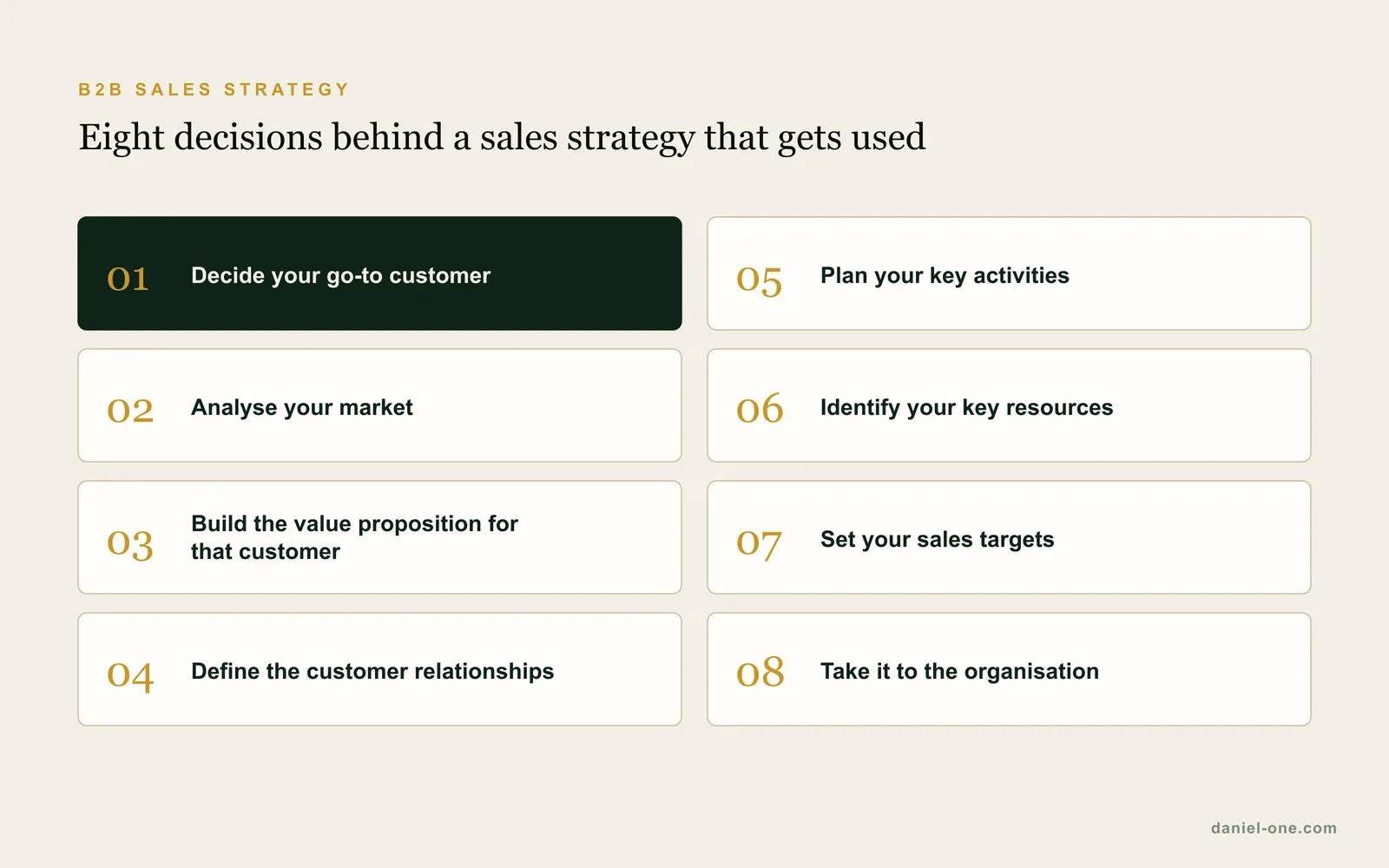
1. Decide your go-to customer
Most sales and marketing teams try to reach too many segments at once. It spreads everyone too thin, and "everyone is our customer" usually means nobody is.
The narrower you go, the better you understand the customer in front of you – their jobs to be done, the gains they're chasing, the pains that keep them up at night, and how they actually buy. That understanding is what lets you anticipate objections before they're raised and pitch in language the customer already uses about their own problem.
One UK-based touch-sensitive technology startup I worked with had a strong product but had never properly defined which industrial verticals to prioritise. Running a proper customer segmentation exercise – working out who genuinely needed the technology versus who might theoretically use it – became the foundation for everything that followed. Once that was clear, the rest of the sales strategy had something to aim at.
Choosing a go-to customer doesn't mean refusing business from anyone else. It means your resources – your messaging, your sales activities, your product roadmap – are built around the customer who gets the most value from what you do. And don't forget: your go-to customer includes the customers you already have. Your strategy needs to say how you'll grow those relationships, not just how you'll find new ones.
This is where a proper customer profile earns its place. If you haven't built one – or the one you have was put together in a boardroom rather than from real customer conversations – start with building accurate B2B buyer personas before you go further with this strategy.
2. Analyse your market
Once you know who you're targeting, the next question is where they are and how many of them exist.
How many target customers do you have in each region, each country, each segment? Are there a few hundred concentrated in one market, or a handful scattered across many? Which markets are mature for your product, and which are still developing?
This is unglamorous work, but it's the difference between a sales strategy that's aspirational and one that's executable. A target market of "everywhere" isn't a target market – it's an admission that nobody's done the analysis. Start with the customers you can realistically reach in the next twelve months, not the full theoretical market – the gap between those two numbers is usually where the strategy goes wrong before it's even written.
I've seen companies discover, once they actually mapped this out, that their entire addressable market in a "priority" region was smaller than a single city elsewhere. That's not bad news. It's the kind of clarity that lets you stop guessing – and it often points straight back to step one, because a market that small might mean the go-to customer needs rethinking before you spend another pound chasing it.
3. Build your go-to customer value proposition
Once you know who you're selling to and where, it's time to get specific about why they should buy from you rather than anyone else.
What value do you deliver to this customer? Which of their problems are you solving? What combination of product and service are you offering, and which of their needs does it satisfy?
This is value proposition work, and it deserves its own focus rather than a few lines here. If you haven't done this properly – or your value proposition currently describes what you do rather than what the customer gets – this is the single most common gap I see in B2B companies, and it's worth fixing before you build anything else on top of it. You can also get the free Value Proposition Playbook and work through it directly.
Once the value proposition is clear, the next job is making it land – through storytelling that builds genuine interest in your product, not just a features list. That's a skill in its own right, and one most B2B sales teams underinvest in.
4. Define your go-to customer relationships
How will you build and maintain the relationship with this customer, and how does that fit the rest of your business model?
Some companies go high-touch: a dedicated contact, regular check-ins, hands-on implementation support. Others go low-touch: self-service onboarding, support via chat, customers who largely implement the solution themselves. Neither is right or wrong – but it has to match the value proposition you just defined, and it has to match what you can actually afford to deliver.
This decision also shapes your sales process – how prospects move from first contact to closed deal, and what happens once they're a customer. If you haven't mapped that out yet, designing a sales process around how your customer actually buys is the next logical step after this one. Or get the free Sales Process Playbook and work through it with your team.
To work through the whole method with your team, get the free Sales Process Playbook: 44 slides and 17 editable canvases in PowerPoint.
If you're working through this and realise your value proposition and sales process don't quite line up – that's worth fixing before you go further. Start with the value proposition guide or the sales process guide, whichever feels like the weaker link right now.
5. Plan your key activities
With your focus, your value proposition, and your relationship model in place, it's time to get specific about what actually needs to happen.
What does your sales strategy require in terms of activity? What do your customer relationships require? What do marketing, product, and service need to deliver to help close deals? How will you generate interest, and what happens once you have it?
Some of this is one-off – better onboarding materials, a redesigned demo. Some of it is ongoing – a quarterly check-in cadence, a recurring content programme. The strategy doesn't run itself. If the activities aren't listed and owned, they don't happen.
6. Identify your key resources
Every plan needs resources – money, time, people, tools. List what your sales strategy actually requires, and be honest about what's missing.
"Resources" doesn't only mean budget. If you're building a strong onboarding experience, that might mean a proper product guide, someone with the skills to run demos, and the right tools to support it. This is also the stage where reality checks in. You might realise the original plan was too ambitious for your current resources – and that's useful information, not a failure. It might mean narrowing your target market further, or shifting from in-person to digital delivery because it's what you can actually sustain.
7. Set your sales targets
Build targets for both new prospects and existing customers, broken down by region or segment. How many deals do you plan to close, and over what timeline? How many prospects need to be contacted each month to get there? How many existing customers need a conversation about expansion?
This is where the strategy becomes measurable. Without it, steps 1 through 6 are still just intentions.
8. Take it to the organisation
If you've worked through the first seven steps, you now have a sales strategy that's grounded in who you're selling to, why they'll buy, and what it'll take to get there.
The last step is making sure the rest of the organisation is working from the same picture. That means a presentation that doesn't just summarise the strategy but builds the case for it – clearly enough that other departments understand what's being asked of them and why. I've built channel partner presentations that went through 45 iterations before they were ready – a sales strategy presentation deserves the same level of care, because it's the document that turns a strategy into something your whole organisation can act on.
If you want the underlying thinking behind why some B2B sales operations consistently outperform others – not just on strategy, but on the systems that make a strategy stick – I've written about the seven success factors that separate companies with predictable pipeline from those relying on individual talent.
A sales strategy is a sequence of decisions, not a document
Most companies have pieces of this already – a value proposition somewhere, a rough idea of their target customer, a sales process that's mostly working. What's usually missing isn't any single piece. It's the connective thread between them, and the discipline to revisit the sequence as the market, the team, or the product changes.
I worked with a company that had built a strong reputation in one niche market – golf course technology – but had never properly mapped how the same value proposition could extend to adjacent markets like equestrian facilities and sports fields. Once we worked through that sequence – go-to customer, value proposition, relationships, activities – for each new vertical, the equestrian segment alone saw sales leads grow by 777% year on year. The product hadn't changed. The strategy had.
If you're working through this and finding that the pieces don't quite connect – your value proposition doesn't match your sales process, or your go-to customer keeps shifting depending on who's in the room – that's exactly the kind of work we do at Up Strategy Lab. See how we approach it.
Frequently asked questions
What is a B2B sales strategy?
A B2B sales strategy is the set of decisions that determines which customers you target, how you reach them, what value you offer compared to competitors, and how you organise your activities and resources to win and grow those accounts. It's built on your value proposition – the reason a customer should choose you over the alternative.
What should be included in a B2B sales strategy?
A complete B2B sales strategy covers your target customer segment, market analysis, value proposition, customer relationship model, key activities, required resources, and measurable sales targets. Most strategies are missing one or two of these – often the market analysis or the resource planning – rather than starting from scratch.
How is a sales strategy different from a sales plan?
A sales strategy sets the direction – who you're targeting, why they'll buy, and how you'll engage them. A sales plan is the operational detail underneath it – specific targets, territories, activities, and timelines. The plan only works if the strategy underneath it is sound.
How often should a B2B sales strategy be reviewed?
At minimum, annually – but the better practice is to treat it as a living set of decisions rather than a once-a-year exercise. Buyers do most of their research before ever speaking to a salesperson, and how they research changes constantly – if your strategy hasn't been revisited in over a year, it's likely built on assumptions about your market that no longer hold. Building a sales strategy alongside other foundational pieces? Start with how to create a strong value proposition for B2B, then build out your buyer personas, and design a sales process that matches how your customers buy. For the systems that make a strategy stick once it's built, see the seven success factors for B2B sales. Read the manifesto
Related guides
Build a strong value proposition Design your B2B sales process Build customer profiles and buyer personas Build a reseller channel partner program
The Visibility Edge
Tested ideas on building better B2B companies, when there is something worth sending.